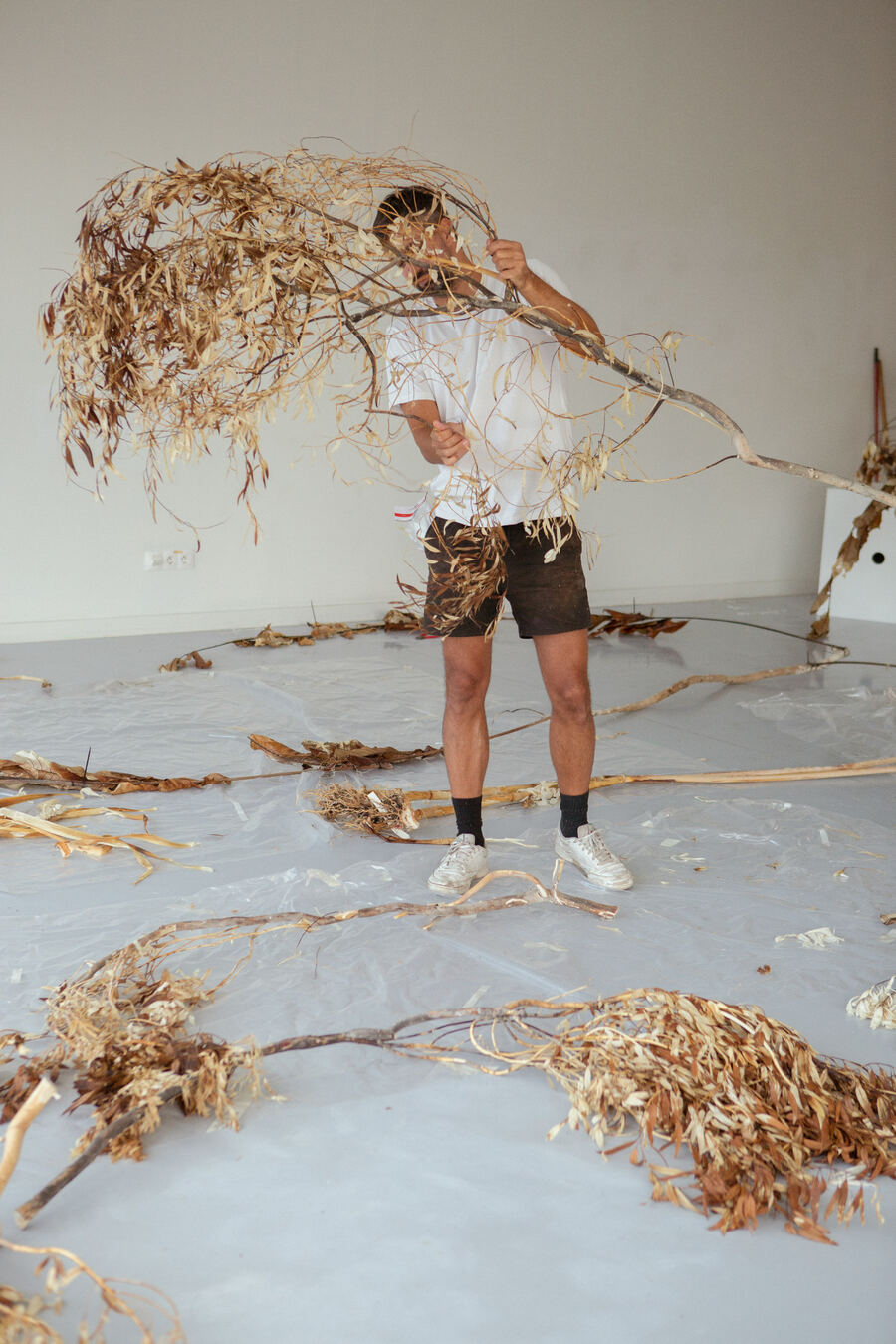
Luca Vanello’s work moves through unstable territories: between living and non-living matter, care and control, preservation and transformation. In this conversation for Art-onomi, he reflects on the body, material vulnerability, technology, chance, time and the possibility of creating artworks as responsive environments rather than fixed objects.
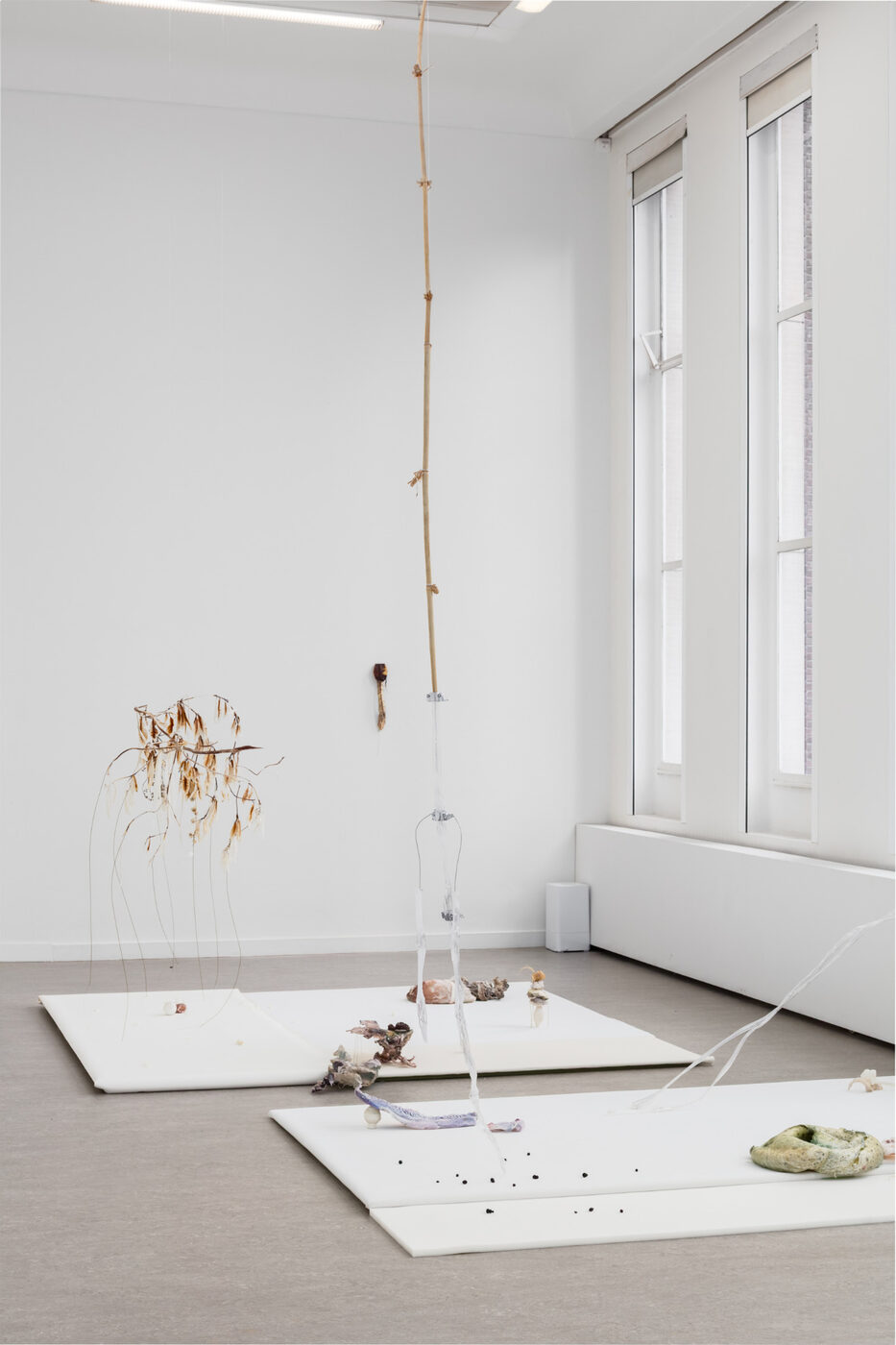
1. In many of your works, something seems to remain suspended between two states: alive and dead, natural and artificial, cared for and manipulated. Are you particularly interested in the moment when something stops belonging clearly to one category?
I am very interested in that moment when a category stops feeling stable. I often begin with things that seem to enter the studio with clear identities: a plant, a prosthesis, a synthetic polymer, a medical component. Through transformation and composition, I try to bring them to a point where those identities become less certain. A plant from which I remove chlorophyll can begin to look strangely artificial, while a 3D-printed prosthetic element can start to resemble something organic or bodily. I like that reversal because it interrupts the habit of immediately deciding what something is and therefore opens new possibilities on how to relate to it.
For me, this suspension is not simply about producing ambiguity. It is a way of questioning the separations we rely on: living and non-living, natural and technological, vulnerable and functional, cared for and controlled. I am also interested in how many of these boundaries are human-made conceptual divisions that help us organise the world, but do not necessarily reflect how things actually exist and relate. The distinction between living and non-living, for example, can appear very clear when considered as a category, while materially the two are continuously feeding into one another. When a tree dies, its relation to life does not simply end. Its body immediately becomes inhabited by fungi, insects and microorganisms; it decomposes, releases nutrients, and gradually becomes part of the fertile ground from which other forms of life can emerge. What we call non-living matter is therefore often deeply entangled with processes that sustain the living. These boundaries become much more porous when we pay attention to transformation, circulation and dependency.
Those oppositions are often much less clear in reality than we imagine. A prosthesis, for example, is technological, but it exists because a body is vulnerable and needs support. A processed plant may no longer be living in the same way, but it still carries its material history, its fragility, and the traces of what has happened to it.
I am attracted to the point where an object no longer fits comfortably into the role it previously had. Once function, appearance, or expected behaviour becomes unstable, another kind of attention becomes possible. I wish for the viewer to hesitate slightly before naming what they see. That hesitation can create a more intimate encounter, because instead of recognising something and moving on, you have to stay with it a little longer.
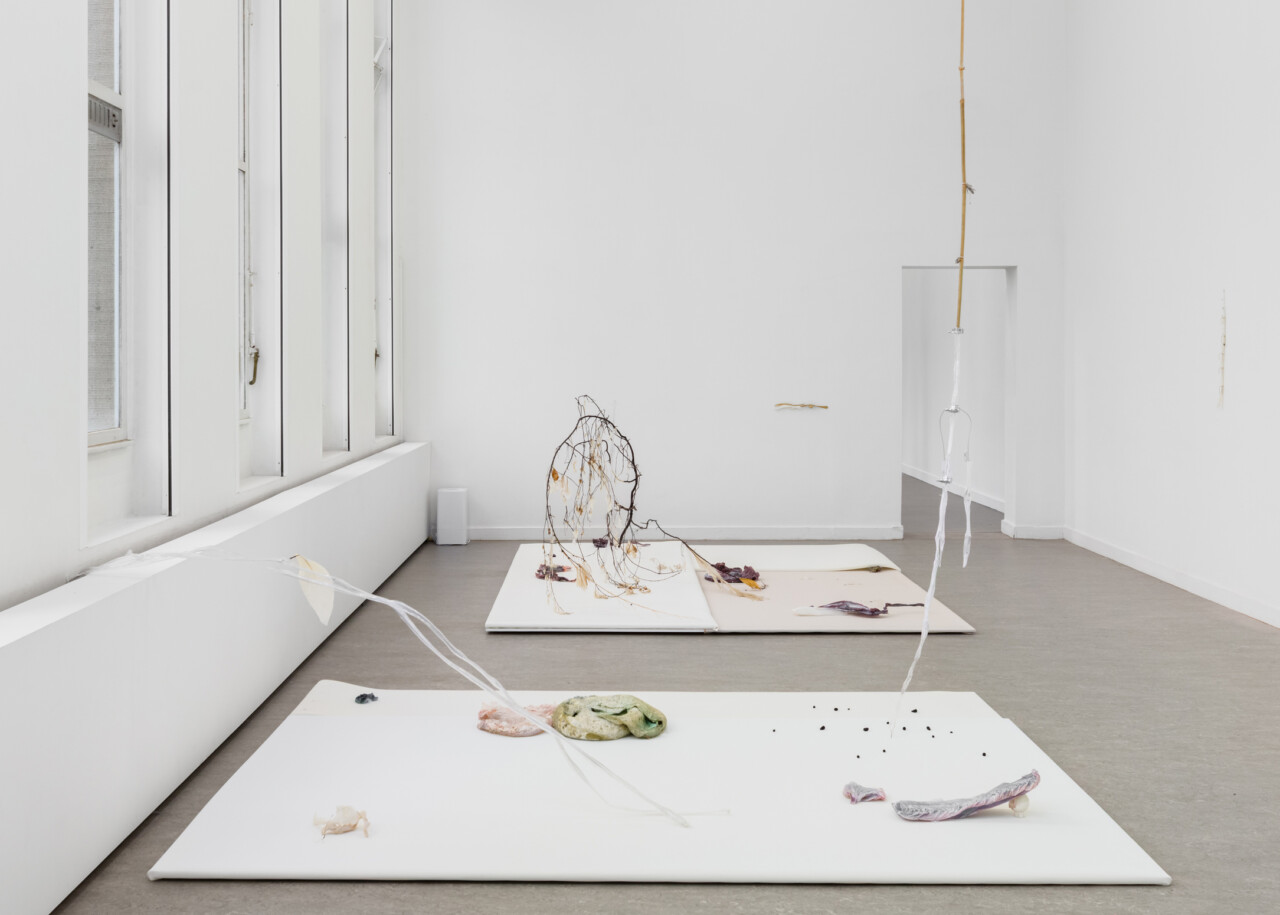
2. You have worked with plants, moisture-sensitive materials, animal prostheses and transformed organic elements. Where, for you, is the boundary between transforming a material and exercising violence upon it?
I am interested in the uncomfortable proximity between care and control. To preserve something can be caring, but it can also mean preventing it from changing. To let something transform can create new possibilities, but it can also damage or exhaust it. Removing chlorophyll from a plant, heating PETG until it becomes malleable, or allowing a hydrogel to dehydrate are not innocent gestures. I want the work to retain some awareness of that asymmetry rather than disguising manipulation as pure collaboration.
I am also interested in the fact that care itself is not necessarily innocent. Care can contain forms of exclusion, control and even violence, because caring for one thing often means making decisions about what is prioritised and what is left outside that attention. A condition that sustains one material may simultaneously weaken another. Maintaining humidity, for instance, might allow a hydrogel to remain soft while causing another material to deform or encouraging mould elsewhere in the installation. The same applies more broadly: preservation always raises the question of what is being preserved, for whom, and at what cost. Attention is selective, and caring intensely for one relation can make other consequences less visible. For me, this makes care much more complicated and interesting. It is not simply a positive gesture, but something that has to remain aware of its own limits, asymmetries and exclusions.
Probably there is no clear boundary between transformation and violence. The transformations I perform often produce materials that I find extremely seductive. Removing chlorophyll creates pale, ghostly vegetal forms; heating or reversing synthetic objects can produce fragile, almost bodily shapes. I am drawn to the poetic quality that appears through these processes, while at the same time being conscious of the slight sense of violence that produced them. That contradiction is something I want the work to retain. For me, this tension also connects to a broader reflection on technology and its relationship to both life and non-life. I am interested in the way technological processes frequently operate through manipulation, optimisation, correction and control: editing biological cycles, extending capacities, suspending processes, replacing functions, or determining how matter should behave. I am not interested in presenting technology simply as violent or nature as innocent; their relationship is far more entangled than that. What interests me is how technological attempts to organise and redirect natural and material processes inevitably involve some degree of force. Through the work, I try to make this contradiction perceptible rather than resolve it: the attraction of transformation alongside the discomfort of control, a subtle tension between poetics and violence that reflects a much larger and increasingly complex relationship between technology and nature.
What matters to me is how the process creates relations and mutual responses between the materials and me. If a material tears, collapses, dries, grows mould, resists a form, or behaves differently from what I expected, I try not to treat that only as a technical failure, but an opportunity for relation. It becomes information that may ask me to slow down, stop, change pressure, rehydrate, clean, wait, or alter the composition.So perhaps the ethical boundary is not a fixed line. It is a continuous negotiation between intervention and attentiveness. I am interested in making while remaining answerable to what the intervention produces, including when the result is inconvenient, fragile, or different from what I originally wanted.
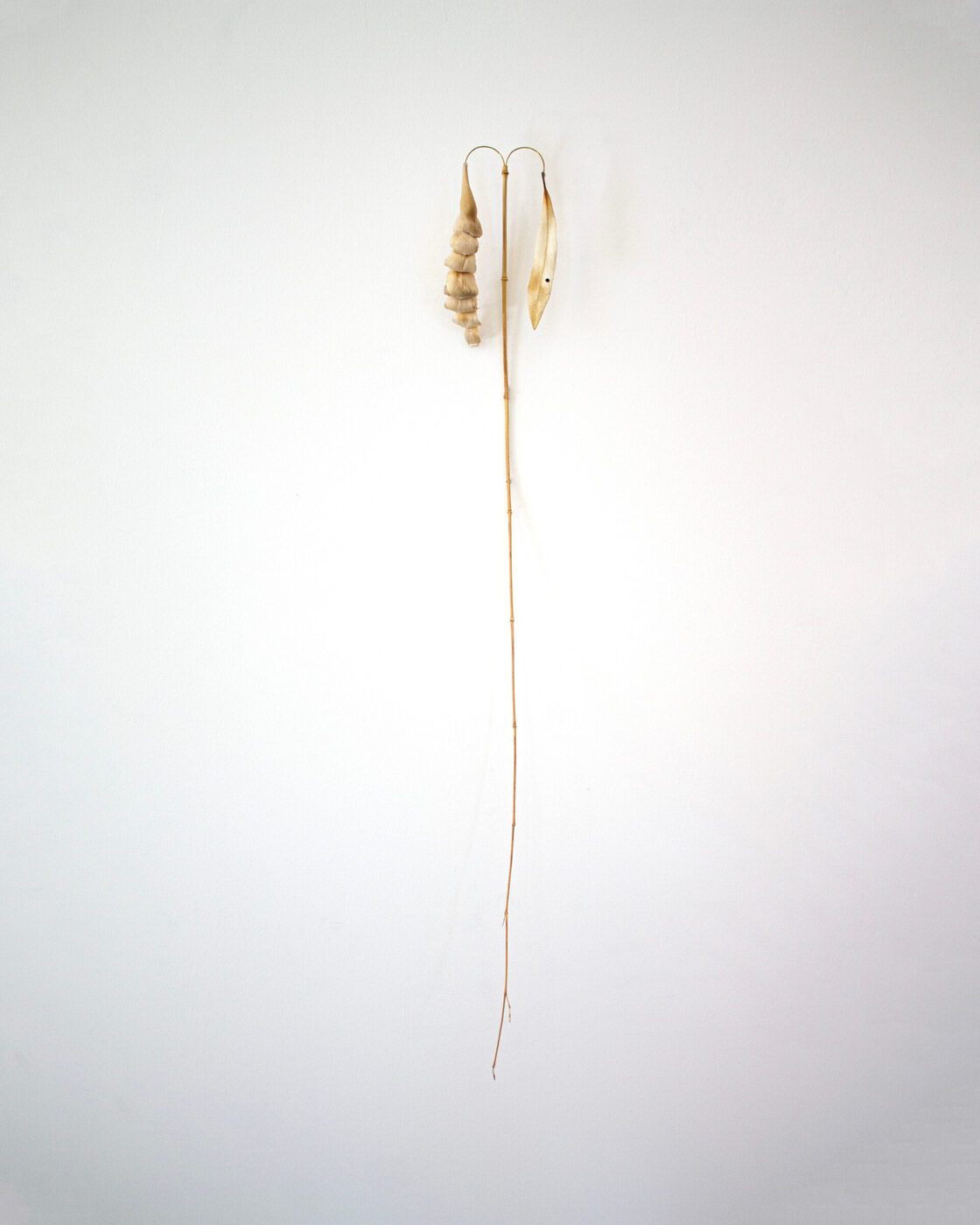
3. Your works can appear extremely fragile, yet the processes behind them are often highly controlled. How much space do you actually leave for chance?
I think the space I leave for chance comes through what I would call creating generous conditions. I do not understand this as simply letting things happen randomly or withdrawing from the process. I still establish many of the conditions: I choose the materials, decide where they are placed, introduce humidity or heat, determine proximity, duration, light, water and spatial relationships. But rather than using those decisions to fix the final outcome, I try to create enough openness for transformations to emerge that I could not completely anticipate. For me, generosity lies precisely in not determining in advance everything that the material is allowed to become.
This has become particularly important when working with moisture-responsive materials such as hydrogels. I can introduce a hydrogel into a particular environment, position a humidifier, add water, or place it in relation to light, warmth, another material or an architectural condition. But once these conditions are created, the hydrogel begins to register them materially. It absorbs and releases water, swells, contracts, curves, dries, changes colour or modifies its surface. The resulting form is therefore not something I have simply designed. It emerges through a relation between my choices, the material’s particular capacities, the atmosphere of room and time.
What interests me most is that this relation does not end once the transformation begins. What the material does then affects what I do next. If a hydrogel dries faster than expected, collapses, retains moisture, begins affecting another material, or changes the humidity around it, I have to respond. I might rehydrate it, reposition it, wait, change the climatic conditions, alter another element, or sometimes decide not to intervene. So the process becomes recursive: I create a condition, the material responds, its response changes the situation, and that new situation asks something different from me.
This is where chance becomes meaningful to me. It is not randomness but emergence within a relationship. The work develops through proposing, observing, responding and adjusting. Creating generous conditions therefore means giving up the ambition to completely master the result without pretending that I am absent from it. I remain responsible for the conditions I establish, but I allow the transformations that emerge from them to redirect both my actions and the artwork itself.
4. Many of your pieces speak about the body without showing it directly. Ideas of breathing, moisture, skin, wounds, prostheses and tissue recur throughout your work. Do you think about the human body while working, or do you prefer to think in terms of broader systems of life?
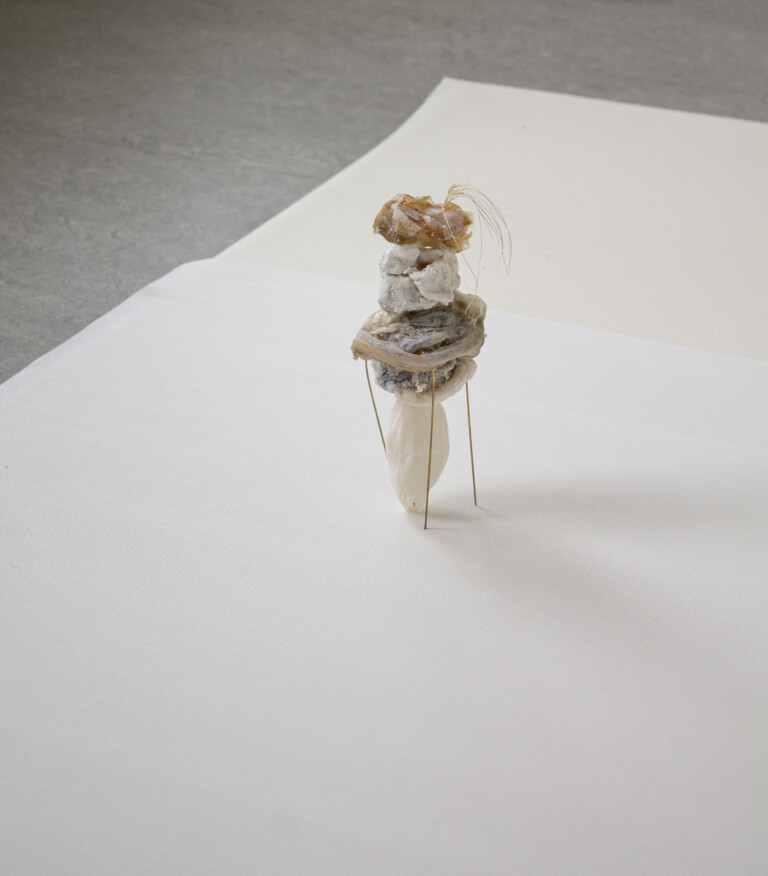
Our bodies are made of water, minerals, bacteria, tissues and chemical processes; they absorb, release, heat, cool, age, tire and continuously respond to the conditions around them. Thinking about the body in this way creates a direct continuity between the human and the materials I work with. The body becomes a way of understanding ourselves as part of matter rather than as something standing apart from it.
This is one reason why ideas of moisture, skin, wounds, prostheses, breathing or tissue repeatedly appear in the work. They point towards a body that is porous, dependent, vulnerable and constantly in relation with its environment. A prosthesis, for example, makes this dependency particularly tangible: it brings together technology, vulnerability and support. At the same time, materials such as hydrogel absorb and release water, PVA softens through humidity, and PETG changes through heat. These processes are very different from what happens in a human body, yet bringing them into proximity allows me to think about shared material conditions such as exposure, transformation, dependency and the capacity to be affected.
Embodiment is also central to the way I actually make work. Throughout my research I have increasingly understood the body and the senses as possibilites for developing a relation with matter and for producing knowledge through artistic practice. I think of this as a kind of stretching of the senses: training myself to become more attentive to temperature, smell, weight, softness, stickiness, resistance, fragility, moisture, pressure and very small material changes. These sensations give information that comes from the encounter itself. A material cools the skin, changes smell as it transforms, resists the pressure of a hand, alters my posture, or asks me to slow down. Through repetition, the body learns how to recognise these differences and they begin to influence the work.
Working with PETG made this especially tangible. Shaping it through heat involves my whole body. I carry and pull the material, hold it while it cools, adjust pressure, change position and respond to its resistance. The same heat that makes the PETG flexible can burn my skin; its weight produces fatigue; the body sweats, muscles tire and grip changes. At the same time, the PETG becomes soft, stretches, scratches, bends and cools. Both bodies are exposed to the encounter. The final sculpture carries that history in its curves, tensions, marks and irregularities.
Hydrogel creates another kind of embodied relation. Touching it, sensing its temperature, noticing when it becomes sticky, dry or unusually soft, or smelling a change before it becomes clearly visible are ways of learning what the material is undergoing. These encounters have made me increasingly interested in knowledge that begins sensorially and affectively, before it becomes verbal or conceptual.
So for me the human body and broader material systems come together through embodiment. The body gives an immediate place from which to experience what it means to be affected, to depend on conditions, to encounter resistance and to transform through relation. From there, the work can expand towards other bodies and materials. I increasingly think of the artist’s body as one material body among other material bodies, entering into relations in which each participant has different capacities and vulnerabilities. The sculptures emerge from those encounters, and the viewer later enters them through their own body as well—through proximity, temperature, humidity, scale, smell and movement.
5. Your work repeatedly engages with the idea of stopping, slowing down or altering natural processes. Are you also interested in our difficulty in accepting that everything changes, ages and eventually disappears?
Yes. In many ways, I think an important part of the work comes from our almost endless struggle with the passing of time: the desire to slow it down, optimise against it, preserve bodies and objects, repair what deteriorates, extend functions, and keep things recognisable for as long as possible. Technology is deeply entangled with this desire. We develop ways of prolonging life, preserving organic matter, replacing damaged body parts, storing memory, conserving artworks, and resisting decomposition. There is something very human in this wish to interrupt time, but I am also interested in the tension it creates, because matter never really stops transforming.
Some of my earlier works approached this quite directly through what I think of as editing time. Removing chlorophyll from a plant interrupts and suspends part of its biological process. Materially reversing a 3D-printed prosthesis removes it from the precise functional form that technology had given it. Both gestures speak of human’s attempts to control temporality: to extend, pause, reverse or redirect processes that would otherwise continue without us. But the works also wish to expose how provisional that control is.
More recently, working with hydrogel, PVA and chitosan has made this even more tangible. These materials absorb, release, dry, soften, contract and deform. They continually remind me that preservation is never absolute. Even an artwork that appears stable is only temporarily held within particular conditions. This has made me question whether remaining present necessarily means remaining materially the same. I increasingly find the idea of circulation rather than preservation more interesting. Perhaps something can persist not because its original form is protected indefinitely, but because it enters other relations, leaves traces, changes state, or becomes part of something else. I often think about the image in Diderot’s conversation with d’Alembert, where Diderot imagines taking a marble statue, grinding it into powder and mixing it into the soil. Plants grow from that soil, those plants are eaten, and eventually what was marble has entered flesh. The object disappears as a recognisable object, but its matter has not vanished; it has circulated into another form.
I find that image beautiful because it proposes another way of thinking about continuity and memory. In my own work, a dried hydrogel retains the effects of humidity and temperature; PETG keeps the bends, marks and pressures of its previous transformation; PVA 3d prints carry errors and deformations into whatever happens next. The past does not necessarily survive through an intact original. It can remain present as a material difference, a trace that continues to affect another state or another relation.
This is perhaps where my interest in time is moving now. Instead of asking only how we can preserve something against disappearance, I am interested in what happens if we allow transformation to become a way of carrying something forward. It does not mean celebrating decay or loss. It means considering that continuity might depend less on defeating time than on allowing matter, memory and relations to circulate through it.
6. Beauty in your work often coexists with something uncomfortable, vulnerable or even unsettling. Do you see beauty as a way of drawing the viewer towards subjects they might otherwise resist?
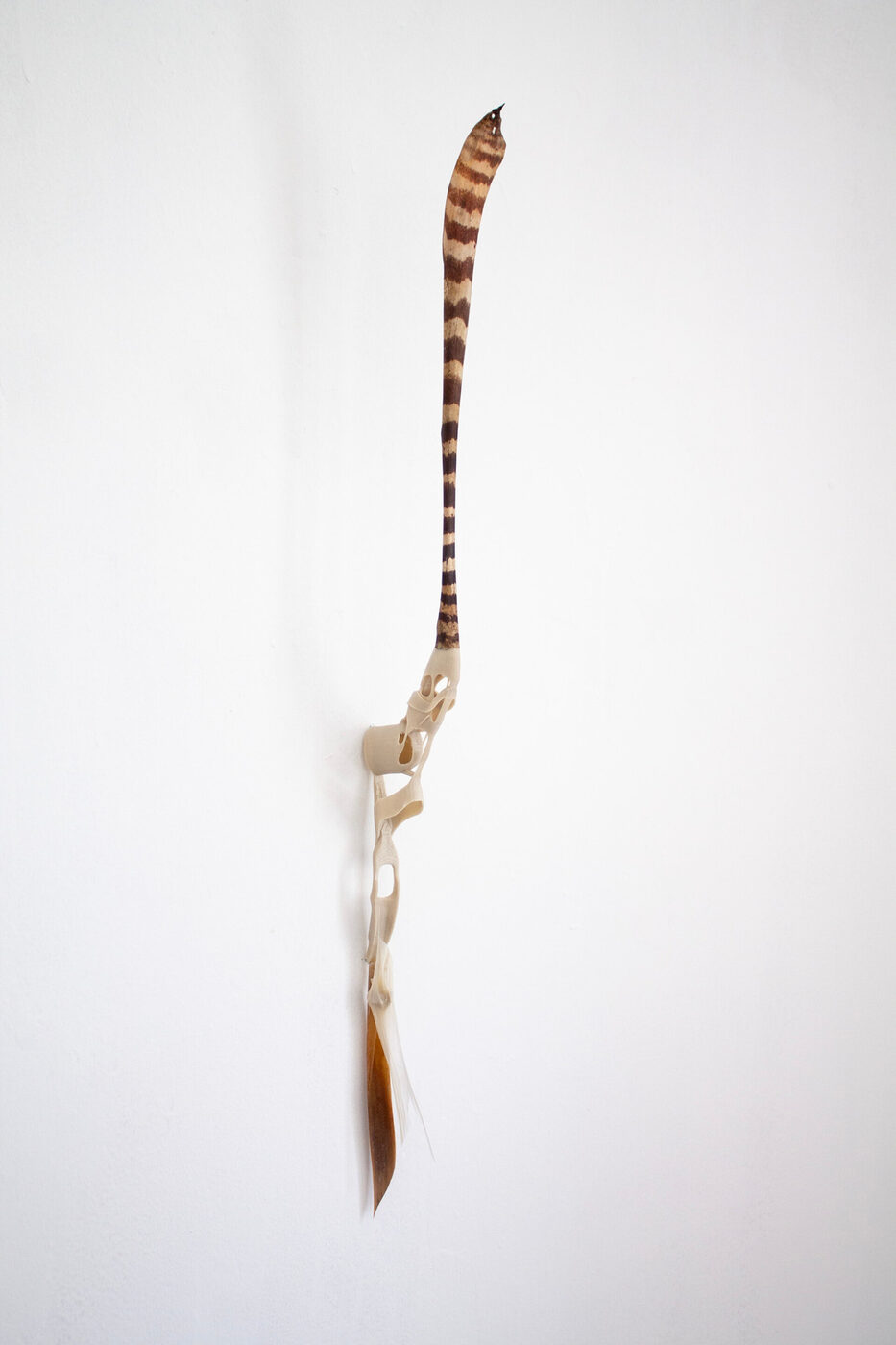
I think beauty can create an opening, but I do not use it as a strategy for making a difficult subject more acceptable. I am interested in a beauty that is slightly unstable—something that attracts you and then begins to produce doubt. A surface may look soft or delicate and at the same time suggest tissue, mould, a wound, a medical device or something in the process of drying. A plant may appear ghostly and elegant, but its appearance comes from a quite radical transformation. That tension is important to me.
I like when attraction and discomfort coexist because they slow down recognition. If something is immediately repulsive, the viewer can simply withdraw. If something is immediately beautiful in a reassuring way, it can become decorative and equally easy to consume. I am interested in the more uncertain territory where a viewer comes closer because something is seductive, then begins to question what they are actually looking at and how they feel in relation to it.
In the installations this can happen through more than visual form. Humidity, coolness, faint smells, softness, transparency, slowness and subtle movement can create an atmosphere that feels intimate or calming, while the same environment can also suggest contamination, decay or vulnerability. I do not want to decide which response is correct.
For me, beauty is valuable when it sharpens attention rather than resolves it. It can make the viewer remain with a material long enough for their first interpretation to become uncertain. That uncertainty is productive. The work does not need to deliver a moral message; it can simply create a moment in which matter feels more present, consequential and difficult to dismiss.
7. You have lived in Trieste, Ljubljana, Bologna, Berlin, London and Brussels. Do you feel that your work comes from a particular identity, or rather from having spent so much of your life between different places and contexts?
Having lived across various cities has probably made the experience of entering and leaving contexts more familiar to me than the idea of belonging completely to one of them. I think that has influenced the way I look at things, even if it is not something I illustrate directly in the work.
Moving between places requires a particular kind of attention. You have to observe how a new environment works, how people relate, what is assumed, what is unfamiliar, and where you position yourself within it. You become conscious that what seems natural or fixed in one context can look completely different in another. I recognise something similar in my artistic practice: I am often interested in things that change meaning when they are displaced from the system in which they normally belong.
A medical component enters an exhibition and loses its purely functional reading. A material encountered through a technical context moves into the studio and becomes poetic, bodily or ambiguous. A plant is transformed until it no longer looks entirely natural. I think my attraction to these shifts may have something to do with being accustomed to translation—not only between languages, but between cultural and perceptual contexts.
I think what these experiences have taught me is to remain slightly uncertain, to observe before assuming, and to understand belonging as something relational rather than fixed. Perhaps the work comes less from a place than from that repeated experience of finding oneself between places and having to renegotiate how things connect.
8. You studied with Gregor Schneider in Berlin. Is there anything from that experience that still remains present in the way you think about space, material or the physical presence of an artwork?
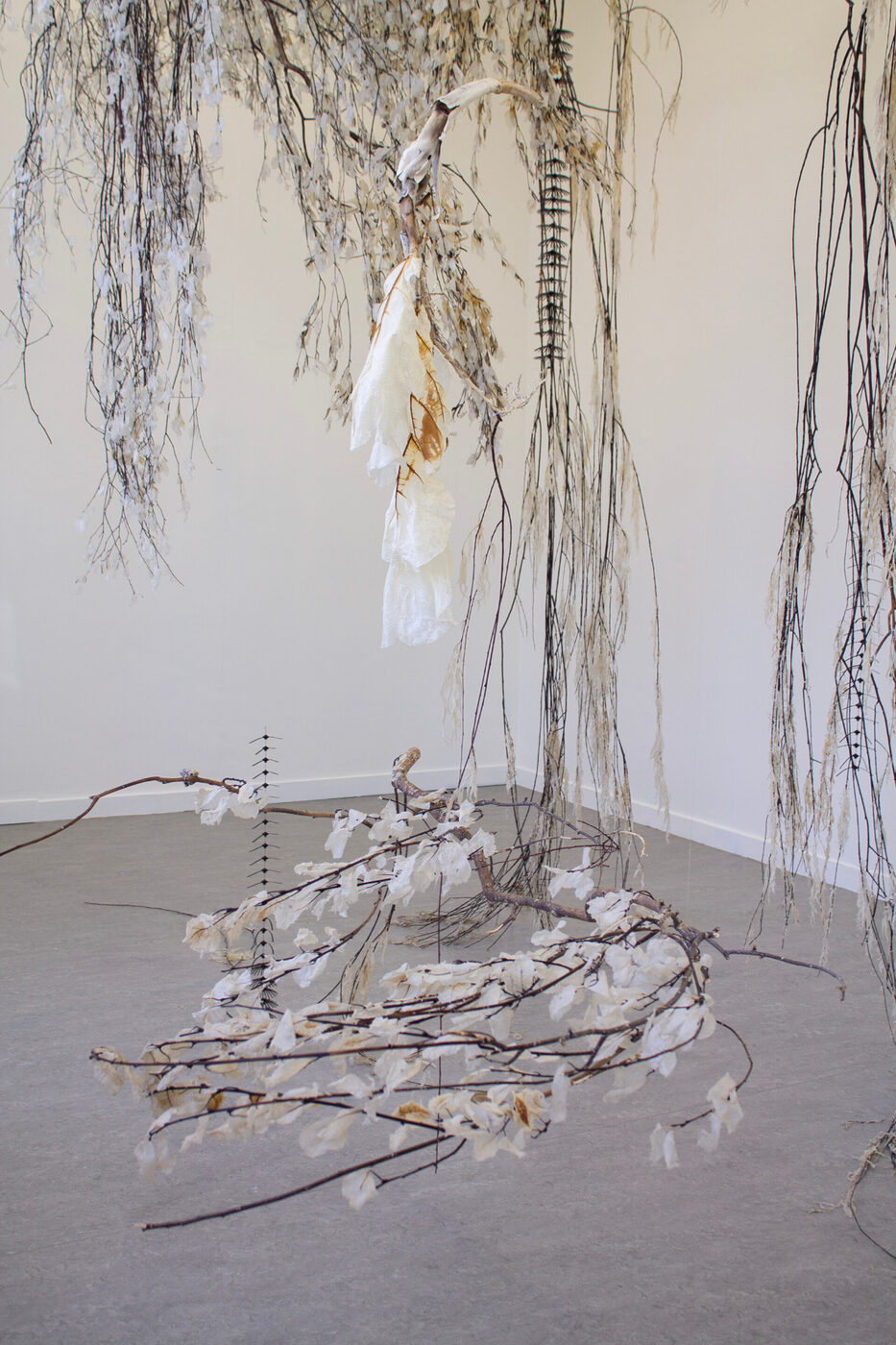
Studying with Gregor Schneider was a very fruitful period for me. One of the things it made me strongly aware of was space itself as a sculptural opportunity. It shifted my attention away from thinking only about individual objects and towards understanding how architecture, bodily movement, scale, proximity and atmosphere can become part of the material language of an artwork. The room is never simply a neutral container. It can shape what an artwork becomes and how a body encounters it.
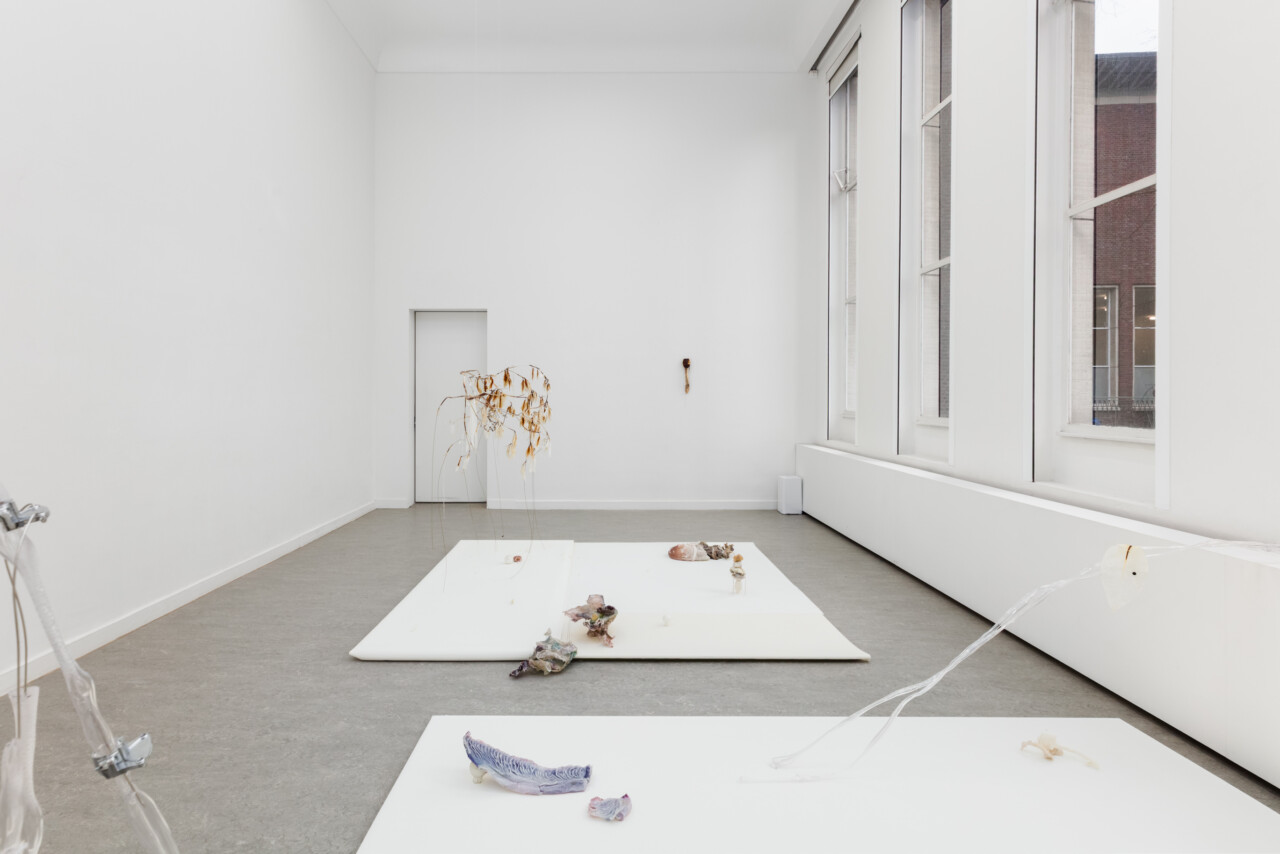
This remains very present in my work, although it has developed in a direction that is increasingly connected to material transformation and environemnt. At the moment, I often think of the exhibition space almost as an ecosystem—or perhaps as a place in which it is possible to invent a temporary, speculative ecosystem. I am interested in exploring conditions in which different things can enter into relation: sculptures, humidity, light, temperature, water, architecture, technologies, visitors and the weather outside. Space becomes sculptural not only through walls, scale or physical intervention, but through the relations and transformations that unfold inside it.
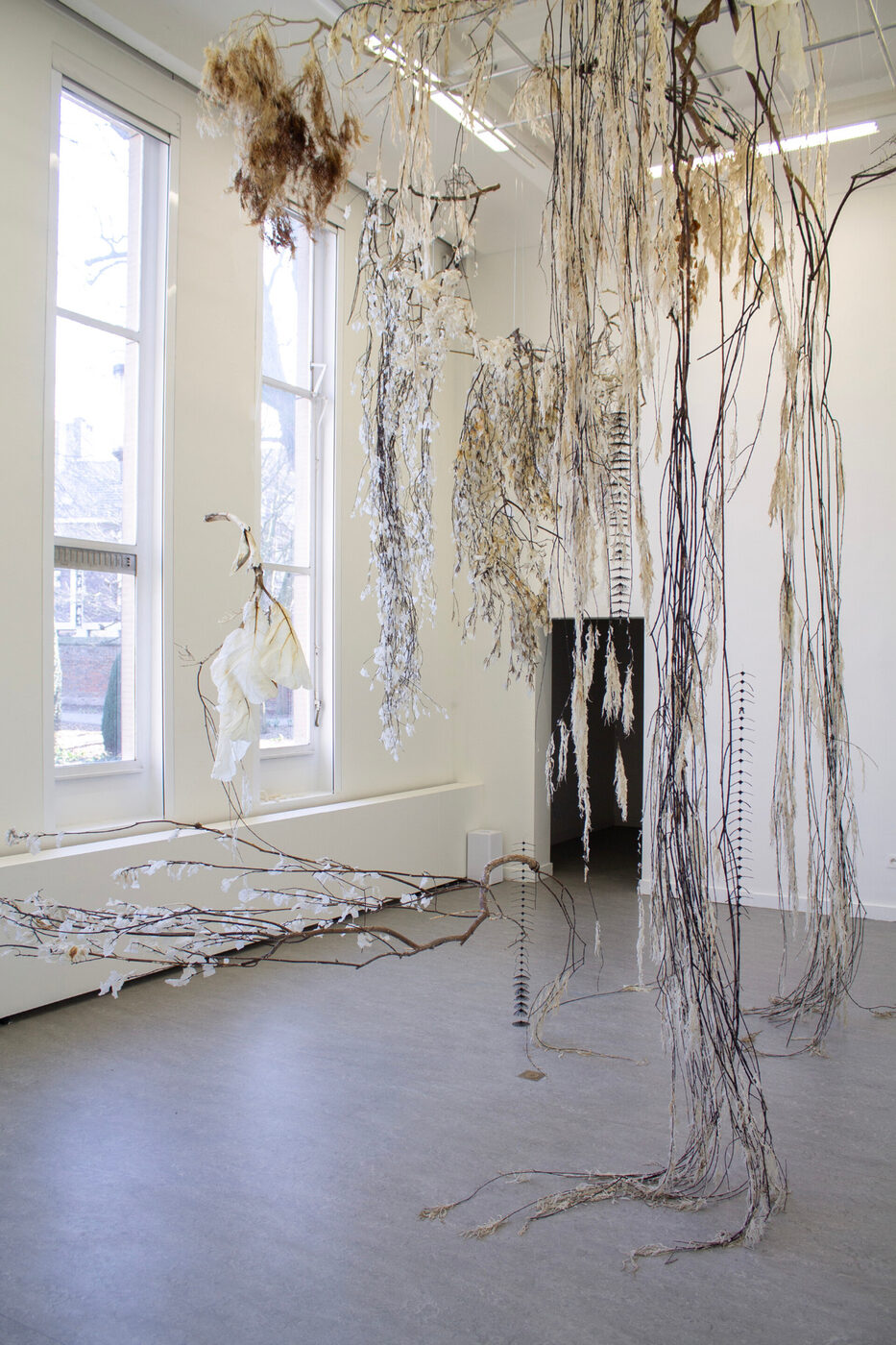
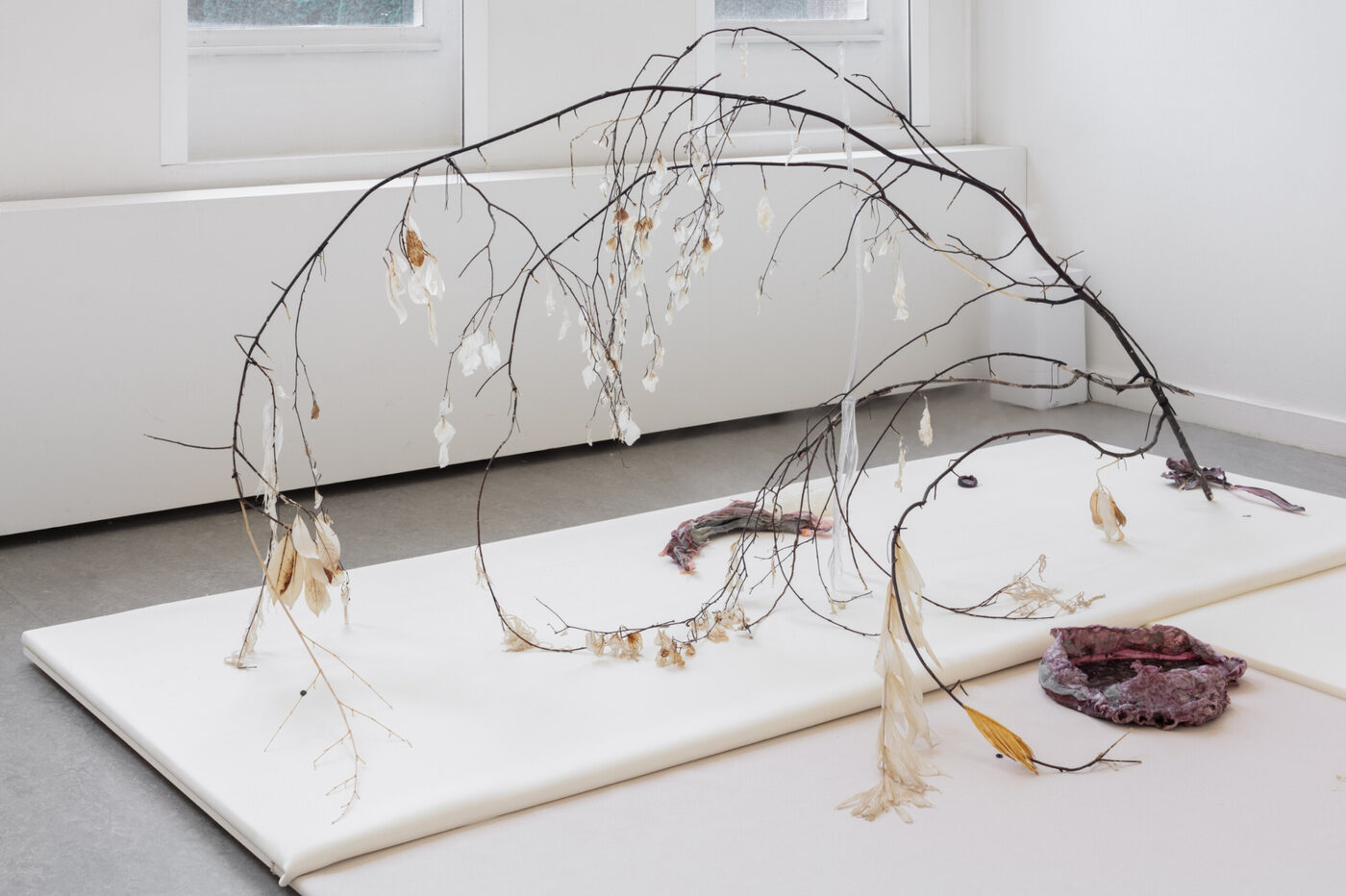
This was particularly important in the exhibition Withering into breath, wetness undoes itself that I presented at Z33 this year. There, I began thinking about the installation as a kind of Hybrid Garden. Humidifiers periodically released moisture into the rooms; large windows allowed sunlight and changes in outdoor weather to affect the temperature; on sunny days the glass produced something close to a greenhouse effect, while colder days created completely different conditions. Hydrogels absorbed and released water according to humidity and heat, chitosan and PVA responded to moisture, and the presence of visitors itself contributed warmth to the space. These elements were constantly affecting one another. In this sense, there was almost a form of weather developing inside the museum.
The idea of the garden has become important to me precisely because a garden is spatial but never static. It is composed, but what is composed continues to grow, dry, react, deteriorate and reorganise itself. Conditions are present, but you cannot completely predetermine what those conditions will produce. I increasingly think of installation in this way: as a speculative environment that slowly develops through time.
So perhaps what started with becoming conscious of space as sculptural has gradually expanded into thinking of space as relational and temporal. The architecture, atmosphere, sculptures and bodies are not separate elements placed together; they participate in producing the environment itself. What interests me now is creating spaces that feel less like settings for artworks and more like temporary ecosystems that the viewer enters and becomes part of.
9. You are currently combining your artistic practice with doctoral research at PXL MAD / UHasselt and Maastricht University. Do you ever worry that academic research can make something overly rational when art may need to remain intuitive, ambiguous or even unexplained?
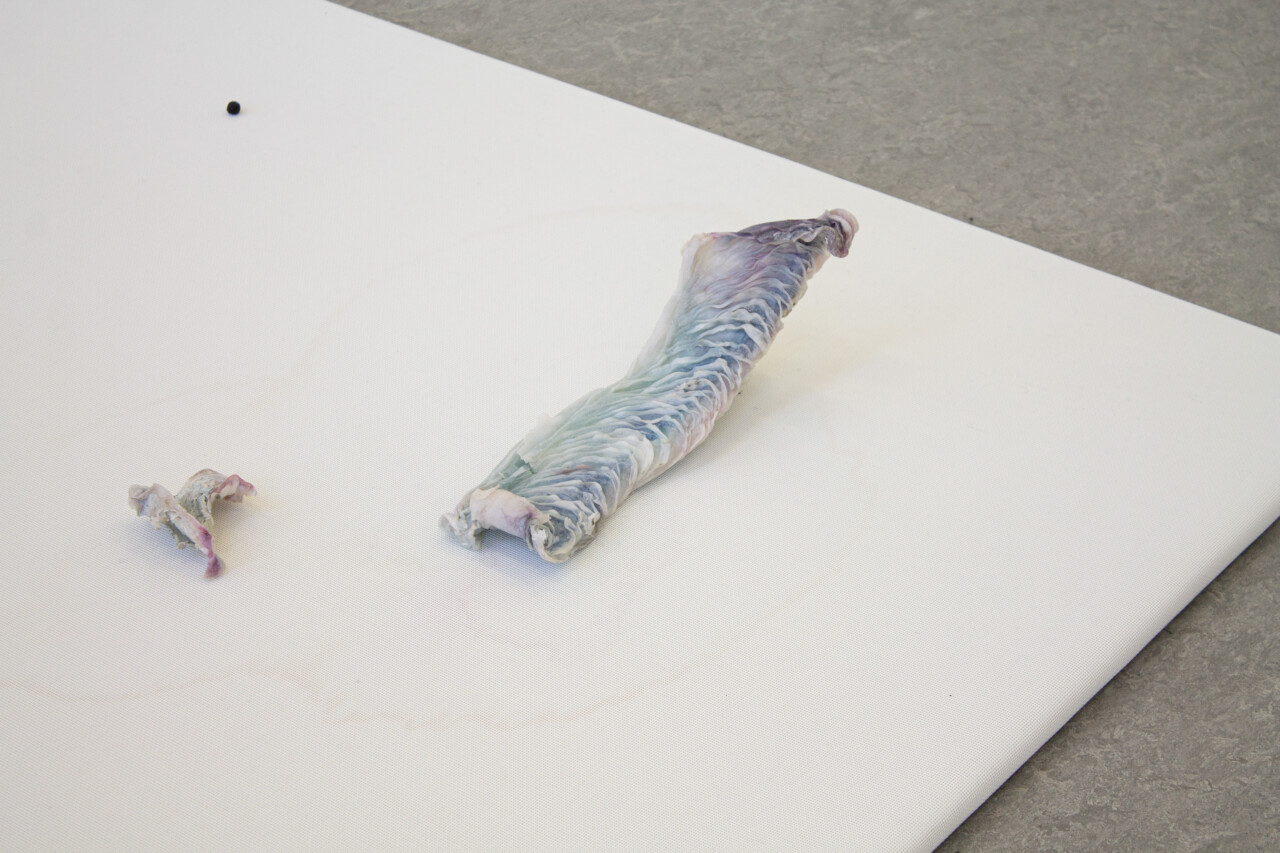
What excites me about artistic research is precisely the possibility of understanding art making itself as a form of inquiry. Certain questions can be explored through making before they can be clearly articulated in words. A material encounter, a bodily sensation, an unexpected transformation or a change in atmosphere can produce a form of knowledge that first appears as something affective and experiential: a shift in attention, a physical response, an intuition, or the recognition that a relation has changed.
This has become increasingly important to me during the past months. I have come to understand the studio as a place where questions can genuinely be investigated through materials. Working with hydrogel, for example, can reveal something about dependency or responsiveness through the physical experience of moisture moving, a form shrinking, or one material altering another. Working with PETG can make vulnerability perceptible through heat, resistance, bodily fatigue and the negotiation involved in shaping it. These experiences produce insights through the process itself, and they often arrive before I have the language to describe exactly what has happened.
The theoretical part of the research then enters into dialogue with these experiences. Concepts give me ways of revisiting what happened in the studio, identifying relations that I sensed intuitively, and making them more precise. At the same time, the artistic process changes how I understand those concepts. An idea such as care, vulnerability or affect acquires a different meaning once it has been encountered through heat, humidity, resistance, maintenance, failure or transformation. Theory and practice therefore develop alongside one another through a continuous exchange.
Writing has become an important part of this process as well. Returning to an embodied experience through writing can reveal something that remained implicit while I was making. That reflection can then return to the studio as a new question, another material experiment, or a different way of composing an installation. The process becomes circular: making produces experience, experience produces reflection, reflection generates another artistic decision, and the new work produces further knowledge.
I have found this increasingly exciting because it allows intuition, material experimentation and critical reflection to reinforce one another. Artistic knowledge can begin through something felt, sensed or encountered physically and gradually acquire conceptual clarity while retaining the complexity of the original experience. For me, this is one of the most compelling possibilities of artistic research: the artwork becomes both a way of exploring a question and a space in which knowledge can be experienced bodily, affectively and materially.
10. The titles of your works and exhibitions often feel physical, sensory and almost poetic. At what stage do they usually emerge: before, during or after the work itself? And do you see a title as part of the work, or more as a way of guiding the viewer into it?
Poetry writing is an important part of my artistic practice, and it develops very closely alongside the sculptural work. I use poetry as a way of returning to embodied encounters with materials and unfolding aspects of those experiences that remain difficult to hold through ordinary descriptive language. After working with a material, I might return to the sensation of its temperature on the skin, its resistance, softness, smell, weight, rhythm, fragility or movement. Through writing, these sensations can remain active and begin generating images, associations and new ways of thinking about the encounter.
I am interested in finding language that is evocative rather than explanatory: words that can carry texture, proximity, tension, atmosphere or bodily sensation. In this sense, the poem becomes another way of working with the material. The encounter continues through language. A hydrogel drying against the fingers, heat passing through PETG, the smell of a changing material, or a particular atmosphere in the studio can all reappear poetically and be transformed into another kind of artistic material.
Poetry also changes how I return to the studio. Revisiting an experience through writing makes me more attentive to what I might notice in the next encounter. It can sharpen my sensitivity towards small changes in a material and sometimes generate another sculptural gesture, spatial relation or installation possibility. There is therefore a circulation between material making, bodily experience and poetic language, with each one feeding back into the others.
The titles of the works often emerge from this process. They may come from a poem, a fragment of writing, a particular combination of words, or a phrase that stays with me while an artwork is developing. Titles such as Withering into breath, wetness undoes itself or Glazed whites chill scapulas, Nocturnal shape reassures through air carry traces of the same physical and sensory encounters that produced the sculptures.
For me, the title becomes another material layer of the work. It brings rhythm, temperature, intimacy, anatomy, movement or an impossible physical action into relation with what the viewer encounters visually and bodily. The title can shift perception slightly, opening another association or another way of sensing the work. Poetry and sculpture therefore remain close to one another in my practice: they are different ways of returning to material experience and allowing that experience to continue unfolding.
11. When an artwork changes physically through humidity, time or its environment, at what point does it stop being exactly the same work?
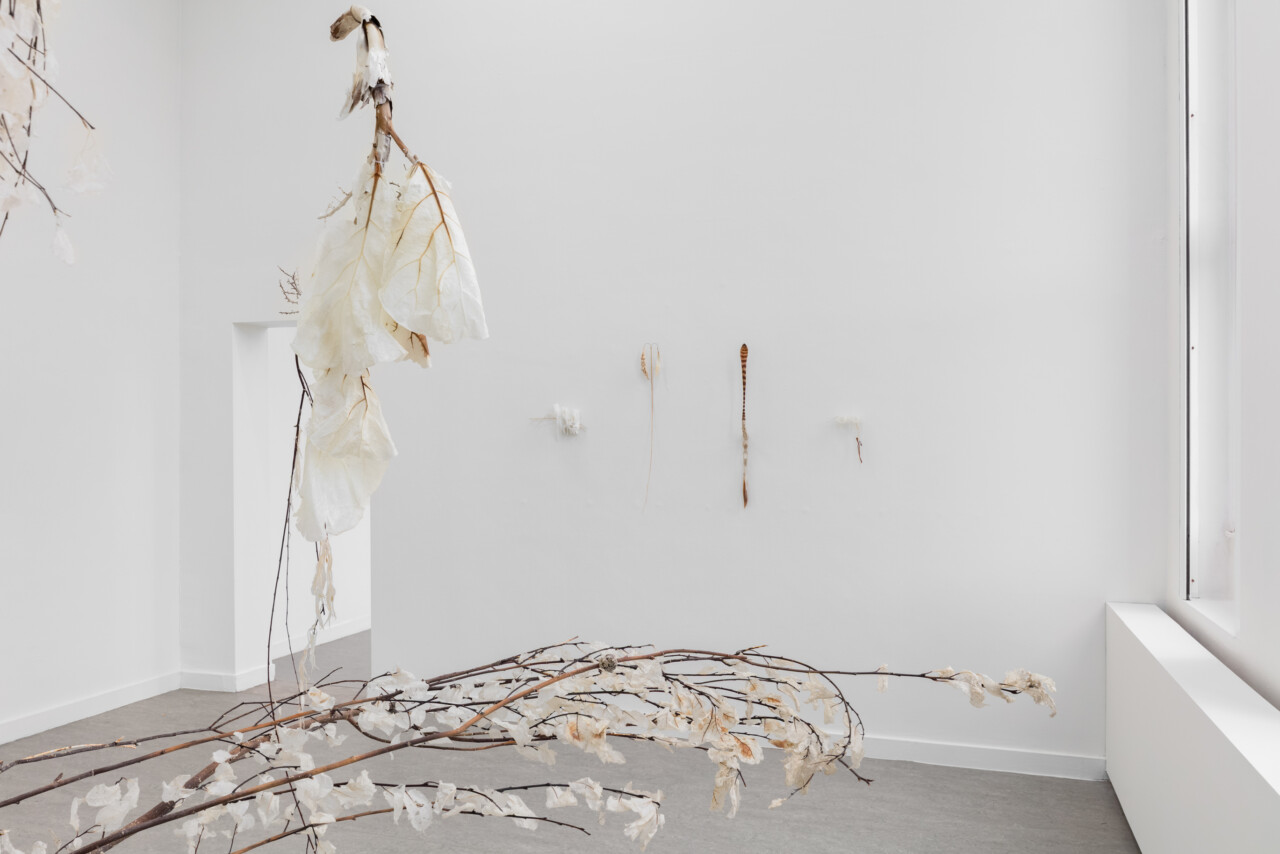
What creates continuity for me is often the set of relations and conditions rather than the exact appearance of every element. A hydrogel may contract, a PVA form may soften, a chitosan surface may crease, or a composition may need to be adjusted. The work continues because these changes are occurring within the material and spatial logic that was established for it. If a work is built around humidity, drying, absorption, heat, maintenance and environmental change, then transformation is not something that happens to the artwork from outside; it is part of what the artwork is. The version seen on the first day and the version seen weeks later can therefore be materially different while still belonging to the same work.
Maintenance complicates this further. If I rehydrate something, clean mould, move an element or replace a component, I am not necessarily restoring an original state. Those interventions become part of the work’s duration. The question is not how to return the installation to day one, but how to keep the relations within it meaningful and able to continue.
There probably is a point at which a work becomes something else, but I do not think that point can be defined by a percentage of material change. It happens when the relations that make the work recognisable are no longer operating—when its conditions, dependencies or tensions have fundamentally collapsed or been replaced by another system.
I like that this remains slightly unresolved. It shifts the artwork from being a stable object to being something closer to an evolving situation, with a history carried in its stains, deformations, repairs and changes.
12. What are you trying to understand through your work right now that you still do not know how to answer?
At the moment I am trying to understand how far I can move from making individual objects towards composing generous conditions in which materials, environments and bodies can genuinely affect and transform one another. I am interested in an artwork that functions as a responsive environment: a situation in which humidity, heat, water, light, architecture, technologies, materials and visitors all participate in what the work becomes over time.
The idea of generous conditions has become increasingly important to me because it changes what composition can mean. Composition can extend beyond deciding where an object is placed or how forms look together. It can also mean creating the conditions through which something is able to emerge: where moisture gathers, which material receives heat or light, how close two materials are to one another, how bodies circulate through a space, or how long a transformation is allowed to continue. These decisions create possibilities for relations to emerge, while leaving enough openness for the materials to redirect what happens next. The artwork then becomes something closer to an evolving system whose composition continues through time.
I am particularly interested in moments when matter can produce a sense of enchantment—when something ordinary suddenly becomes strange, vibrant or unexpectedly present. A material that initially appears inert begins to swell or contract; moisture moves through a room; a surface changes according to weather; something synthetic begins to appear bodily or vulnerable. These small perceptual disruptions can make us become more receptive to what matter is doing.
For me, enchantment is interesting because it begins through sensation before it becomes an idea. It might appear as curiosity, attraction, unease, surprise or a desire to stay with something for longer. The viewer slows down, moves differently, notices humidity on the skin, becomes aware of smell or temperature, or starts paying attention to a transformation that would normally remain unnoticed. Matter becomes more consequential.
I am increasingly interested in whether these experiences can open an ethical dimension within the encounter. I think of this less as communicating an ethical position and more as creating the possibility for what I have started to understand as an ethical rehearsal. For the duration of the installation, the viewer might practise another way of relating: through slowness, curiosity, hesitation, attentiveness to difference, and sensitivity to dependency or vulnerability. The ethical possibility would emerge through the experience itself, through becoming more receptive to the material relations one is already part of.
Perhaps what remains after the encounter is simply a kind of positive suspicion: the sense that matter is more active, vulnerable and relational than we usually allow ourselves to notice, and that our relation to it might therefore be reconsidered. I find this possibility very compelling because the work can invite another form of attention through affect, atmosphere and material presence.
So the question I am carrying forward is perhaps how an artwork can compose the conditions for both material transformation and perceptual transformation: allowing matter to affect other matter while also creating encounters in which viewers become more attentive to those relations. I am interested in how far generous conditions, material vibrancy and enchantment can open possibilities for new forms of care and material togetherness, while keeping the experience open enough for meanings and relations to continue developing beyond what I could have planned.
All images courtesy of Luca Vanello.