Francisco de Goya
Modernity ahead of its time
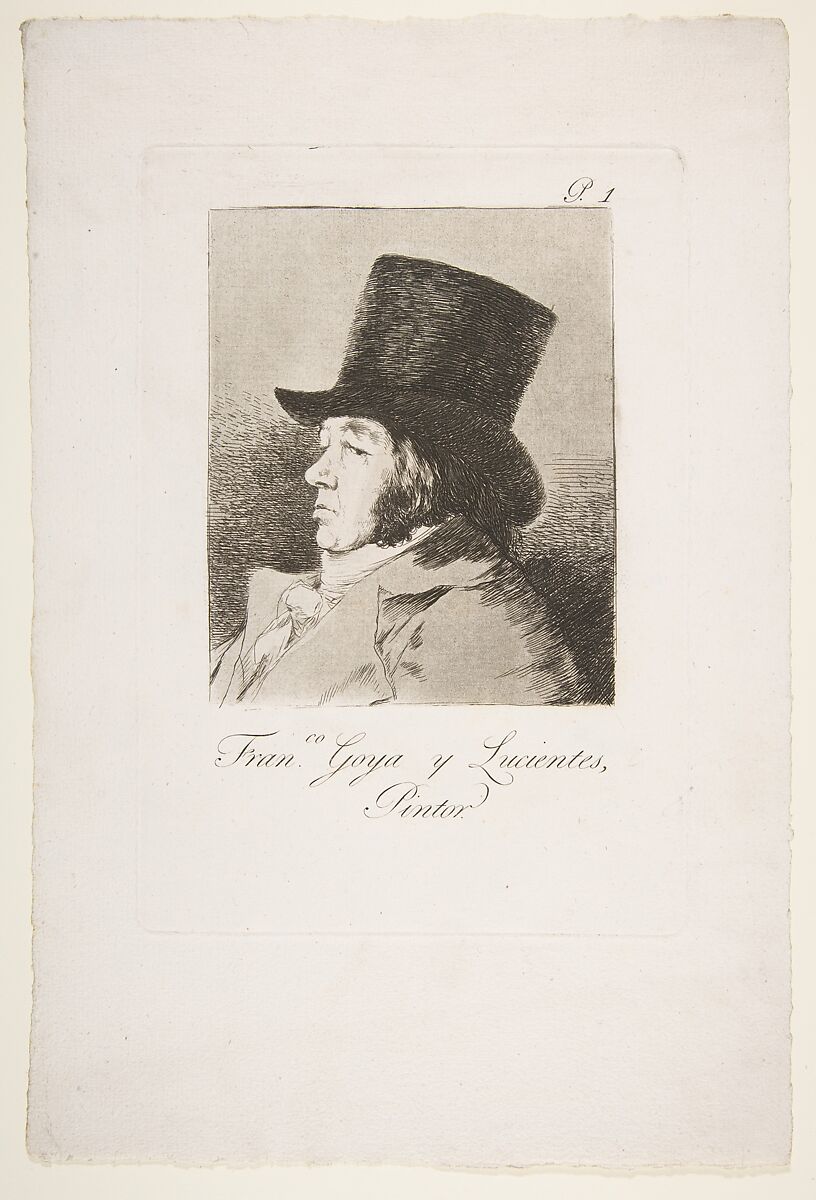
Modernity ahead of its time
A man sleeps over a table. Behind him, the air fills with owls, bats and eyes that do not rest. There is no landscape and no story to offer safety. At first glance it seems simple: a mind defeated by sleep and the creatures that occupy the space when reason withdraws. But even the preparatory drawings suggest that the relationship between reason and imagination was more ambiguous than any single interpretation allows.
The Sleep of Reason Produces Monsters, plate 43 of Los Caprichos, still unsettles us more than two centuries later. Not because Francisco de Goya somehow predicted our time, but because he understood something less comfortable: the irrational does not live outside civilised society. It runs through it. His images do not neatly separate the sane from the foolish, the victims from the executioners, or those who look from those who are looked at. That is where the Goya who still matters begins.
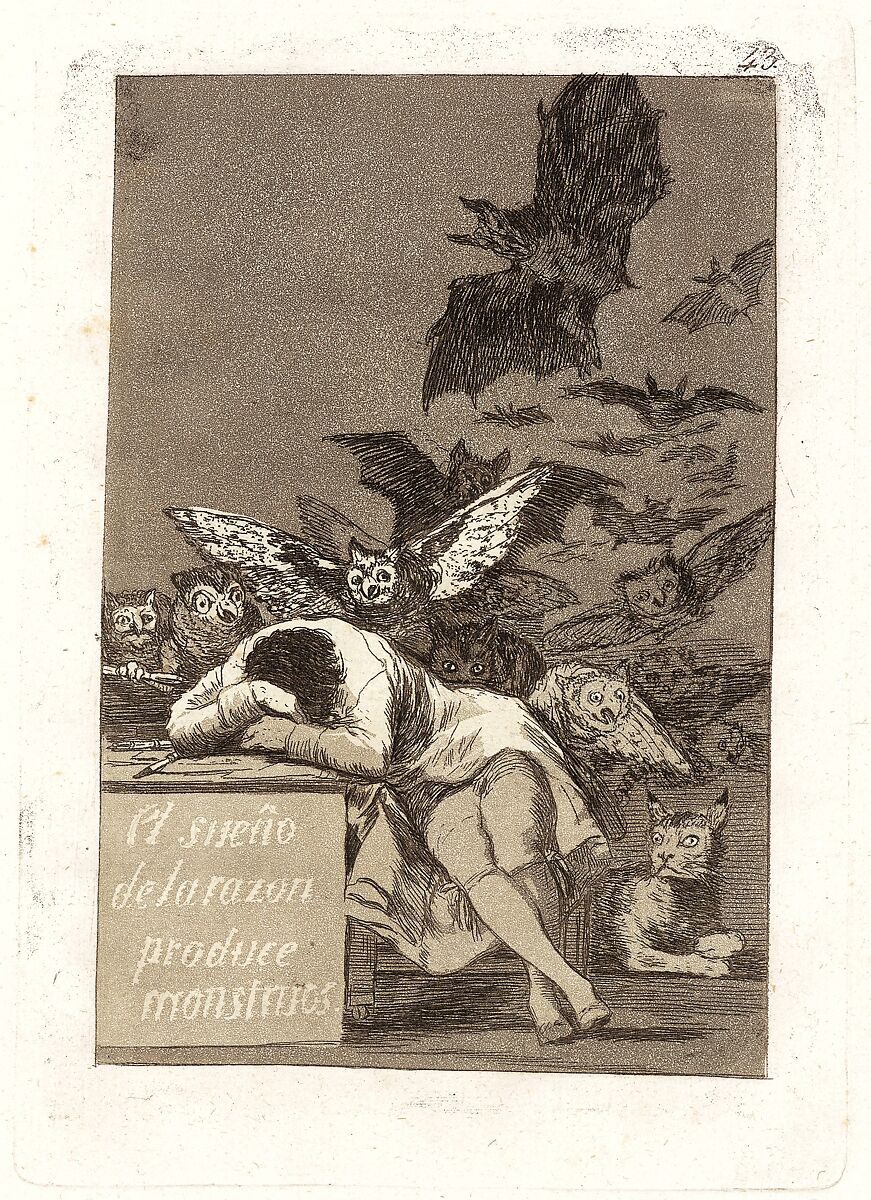 Francisco de Goya, The Sleep of Reason Produces Monsters, 1799. The Metropolitan Museum of Art. Public Domain.
Inside the system, facing its masks
Before he was turned into the painter of nightmares, Goya had built an extraordinary career. He arrived in Madrid in 1775 to work on designs for the Royal Tapestry Factory; in 1786 he was appointed painter to the king and in 1799 became First Court Painter to Charles IV. He portrayed aristocrats, ministers and the royal family. He knew power from the inside because he worked for it and had to negotiate its codes.
That position does not turn all of his work into a secret critique of the court. Nor does it allow us to reduce his career to a transition from a bright painter to a dark one. The tapestry cartoons, portraits, religious work, drawings and print series coexisted. The contradiction is more interesting: an artist integrated into institutions produced, at the same time, some of the least reassuring images of his age.
Los Caprichos: looking means unmasking
In 1799 Goya published Los Caprichos, eighty prints made by combining techniques including etching and aquatint. They are populated by marriages of convenience, superstition, witchcraft, ignorance, desire, abuses and figures of authority transformed into animals. They do not form a manifesto with a single translation. They are visual traps: often we understand that something is wrong before we know exactly what we are looking at.
In ¡Qué pico de oro! (What a Golden Beak!), a parrot addresses a group of listeners. The image does not need to identify a real speaker in order to invite reflection on the authority of speech and the credulity of those who receive it. In Linda maestra (Pretty Teacher), two figures fly together; the Calcografía Nacional classifies it among the satirical prints related to witchcraft, but its meaning cannot be closed within a single allegory.
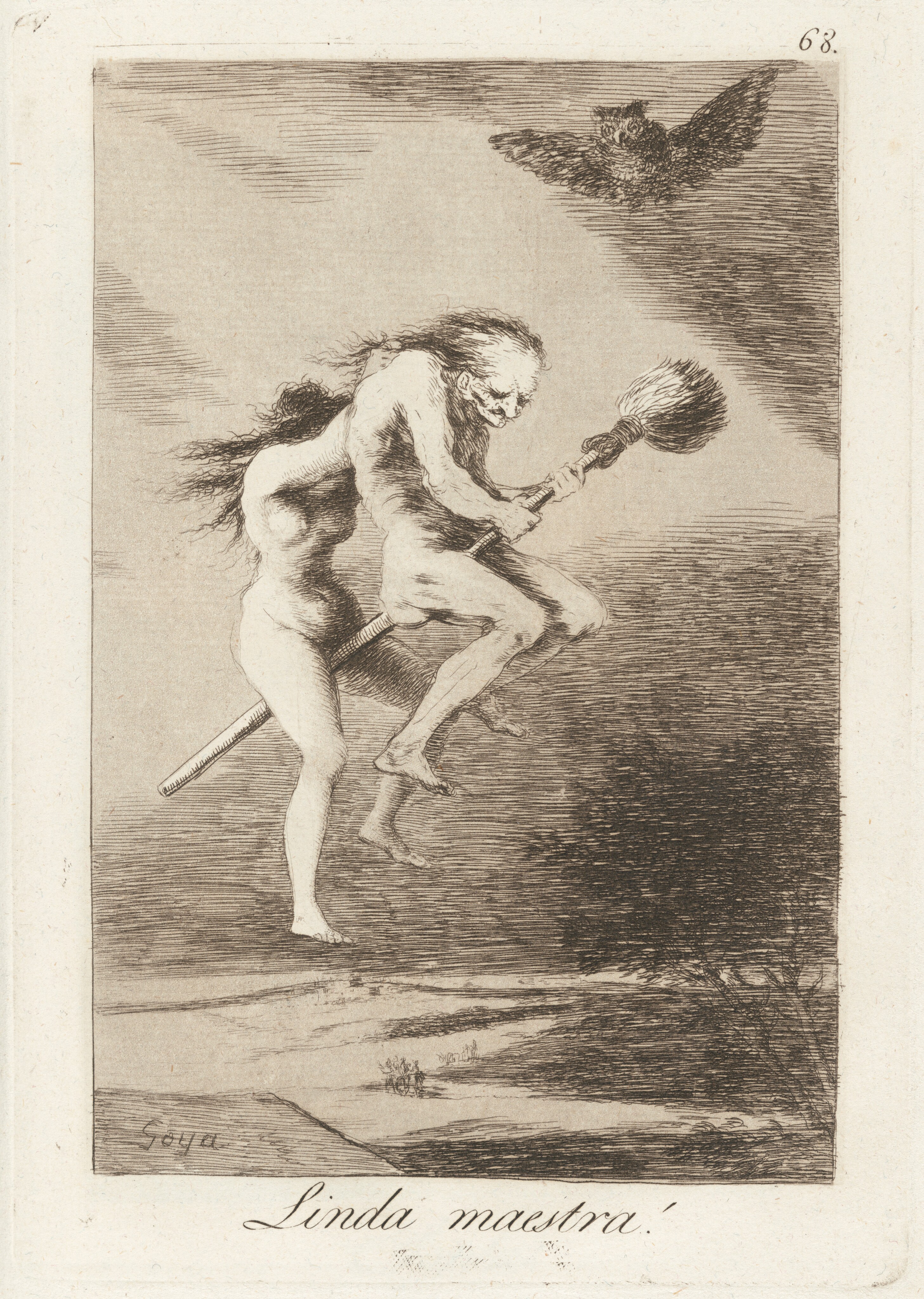
Francisco de Goya, Linda maestra, 1799. National Gallery of Art, Washington. Public Domain.
The Sleep of Reason Produces Monsters is the most famous print, but it does not summarise the series on its own. Reason appears vulnerable and imagination is not simply its enemy: the preparatory drawing shows that Goya explored different relationships between the two. What is modern about Los Caprichos is not that they literally describe our society, but that they expose recognisable mechanisms: credulity, self-deception, fascination with authority and the pleasure of always finding monsters in other people.
War without heroes
Goya did not publish The Disasters of War during his lifetime. The prints were made during and after the Peninsular War; the first edition appeared in 1863. That distance matters: this is neither immediate reportage nor an official story of victory, but a series that shifts war away from glory and towards its human consequences.
In Y no hai remedio (And There Is Nothing to Be Done), a blindfolded man tied to a post bends his body while rifles, very close to him, occupy the edge of the image; other bodies and other condemned men extend the execution beyond him. Violence appears as machinery: someone immobilised, others carrying out the killing and a sequence that seems ready to repeat itself. No se puede mirar (One Cannot Look) introduces another problem. Its title also addresses the person viewing the scene: looking at suffering is never a completely innocent act.
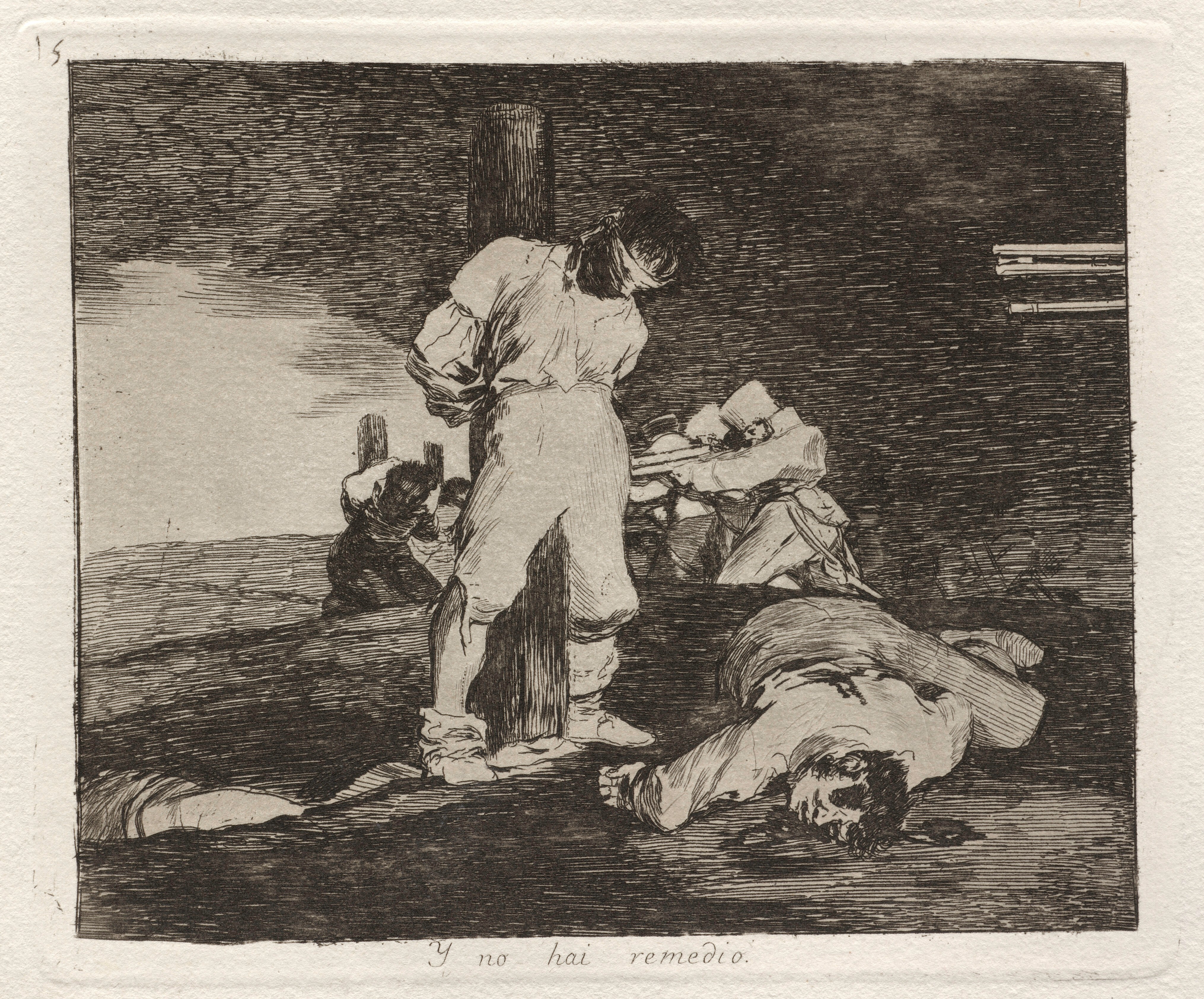
Francisco de Goya, Y no hai remedio, c. 1810–1815. National Gallery of Art, Washington. Public Domain.
In Yo lo vi (I Saw It), the title introduces a testimonial voice, but it does not allow us to assume that every scene corresponds to an event Goya personally witnessed. That testimonial voice turns war, for the viewer, into something seen that can no longer disappear behind the language of power. And in Nada. Ello dirá (Nothing. The Event Will Tell), a corpse writes a word that has provoked mutually incompatible religious, philosophical and political interpretations. We will not choose one as definitive. After death, hunger and fear, Goya offers no repair. He leaves the question open.
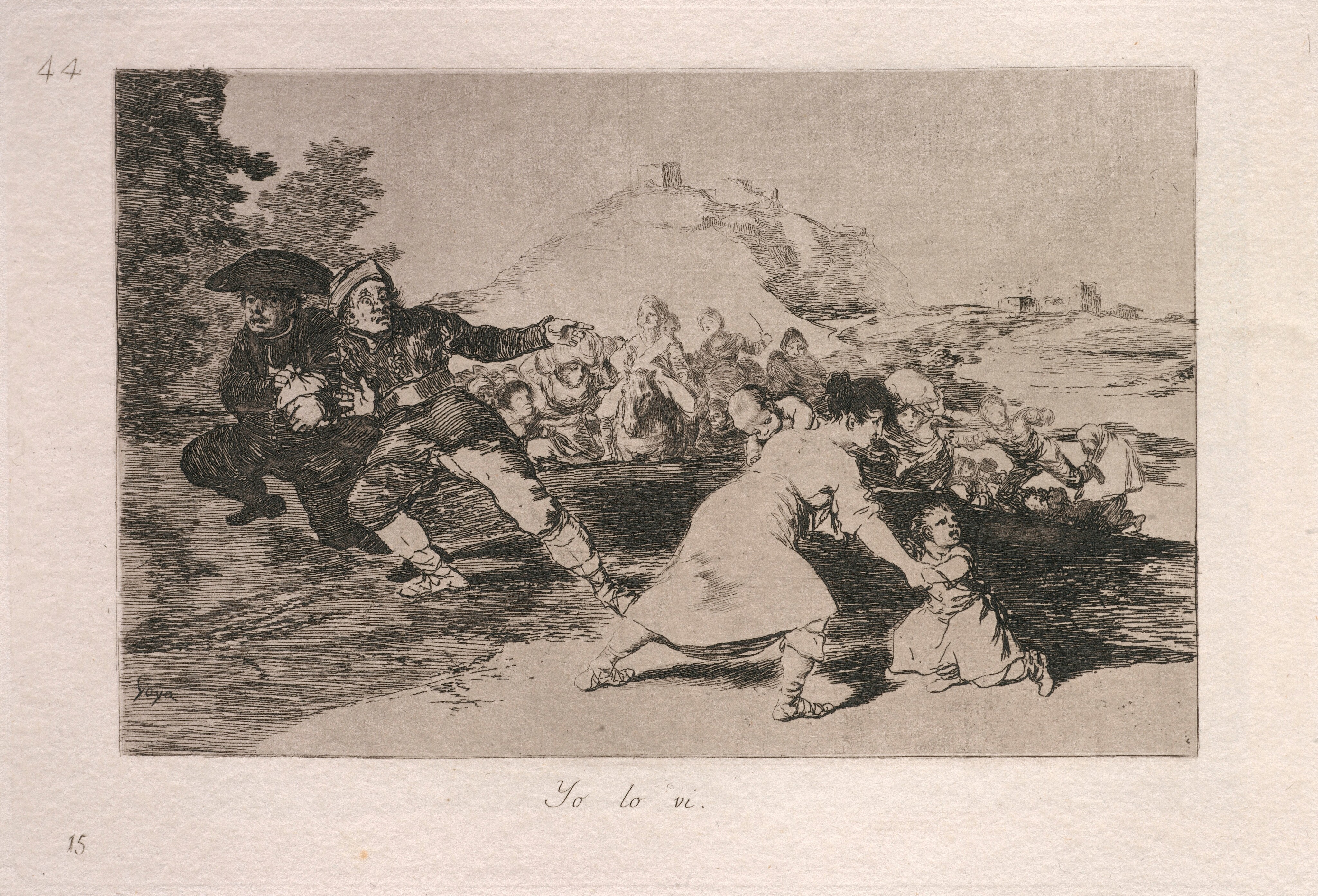
Francisco de Goya, Yo lo vi, published in 1863. National Gallery of Art, Washington. Public Domain.
The body losing control
A serious illness suffered between 1792 and 1793 left Goya permanently deaf. The exact cause remains unknown, and turning it into a total explanation of his work would be an oversimplification. His deafness did not “create” the dark Goya.
But throughout much of his work we find bodies that age, become ill, desire, deform or are subjected to others. In The Madhouse, in the drawings, the prints and later in the Black Paintings, the body stops being a stable form. It can become spectacle, threat, commodity or remains. Goya offers no diagnoses: he shows the fragility of what we believe we control.
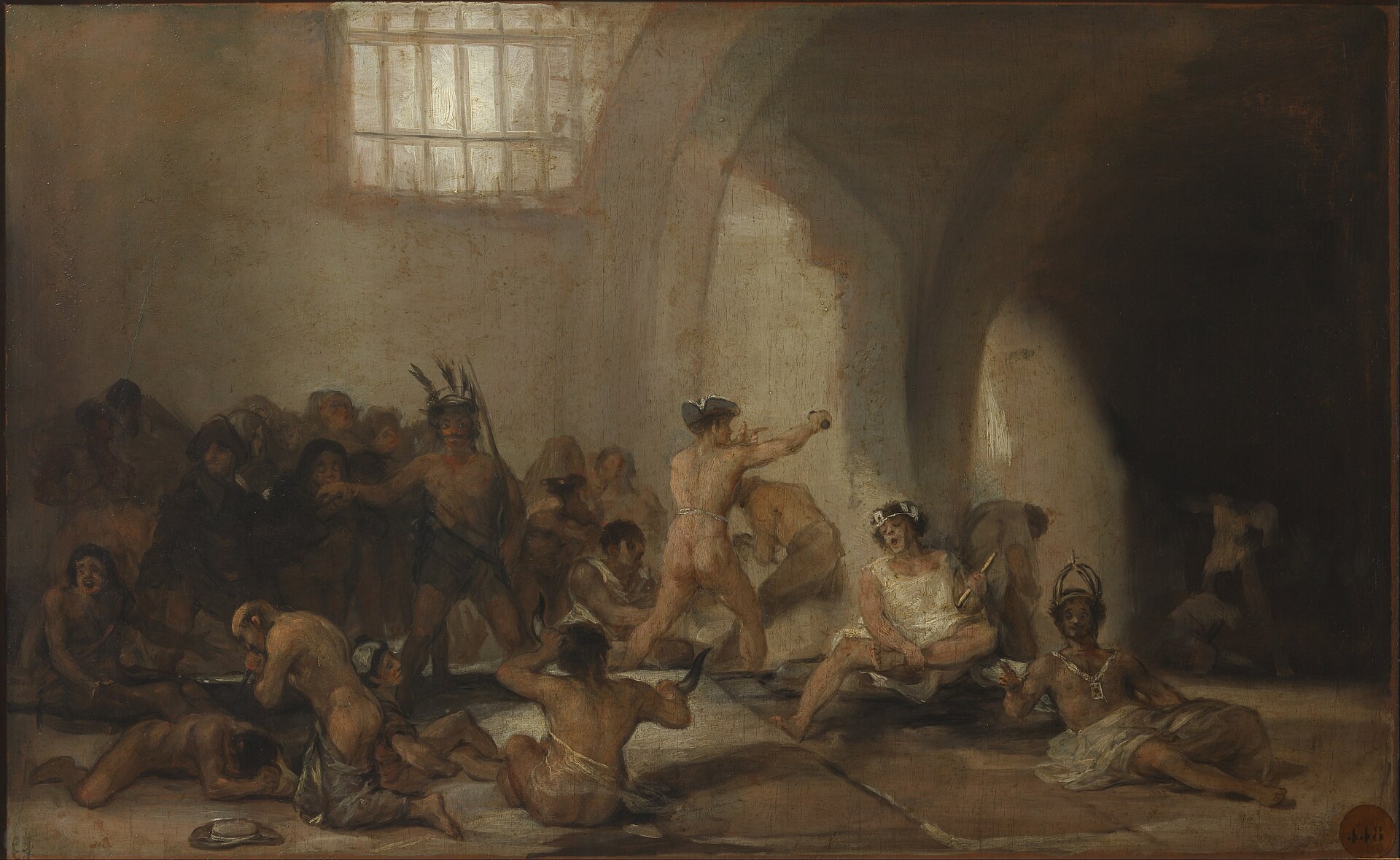
Francisco de Goya, The Madhouse, 1808–1812. Real Academia de Bellas Artes de San Fernando, Madrid. Public-domain reproduction.
The Black Paintings: a house full of uncertainty
In 1819 Goya bought a house on the outskirts of Madrid known as the Quinta del Sordo. On its walls were the fourteen scenes attributed to him that would later receive the collective name Black Paintings. They were murals inside a domestic space, and there is no surviving evidence that they were conceived for public display. Decades later, Salvador Martínez-Cubells transferred them to canvas, an intervention that altered both their support and their material relationship with the original architecture.
No titles given by Goya survive for these works; the names used today came later. Nor did he leave any known explanation of the group. Saturn Devouring His Son has been read through mythology, old age, power and violence; none of these interpretations allows us to state what he intended to say. Witches’ Sabbath gathers figures around an animal presence without revealing an unequivocal narrative. And The Drowning Dog confronts a tiny head, displaced towards the lower edge, with an almost empty expanse occupying most of the scene. Its visual radicalism does not depend on knowing whether the animal is sinking, waiting or simply looking: there is no consensus that allows its meaning to be closed.
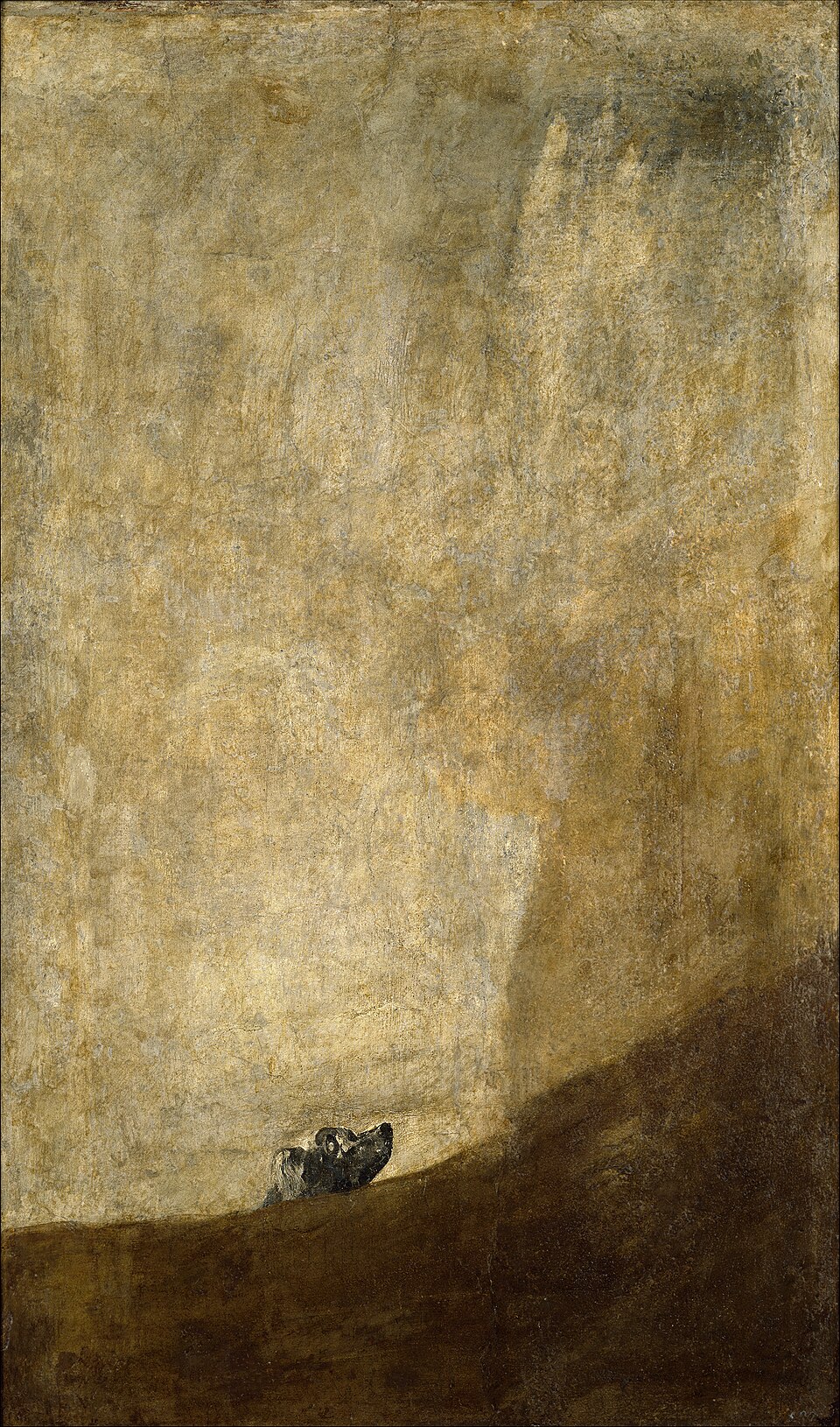
Francisco de Goya, The Drowning Dog, 1820–1823. Museo Nacional del Prado, Madrid. Public-domain reproduction.
The authorship of the group has also been questioned by one strand of scholarship, although the Museo del Prado maintains the attribution to Goya. Acknowledging the debate does not require pretending that every position has equal support. The responsible approach is to distinguish the museum’s current attribution from the open questions concerning titles, arrangement, transformation and meaning.
Modernity is not prophecy
Saying that Goya anticipated Romanticism, Expressionism or Surrealism is tempting, but it confuses retrospective similarity with demonstrated influence. His work had a profound influence on many artists of the nineteenth and twentieth centuries, although each generation constructed its own Goya: the satirist, the visionary, the witness to war, the painter of the monstrous.
Perhaps his modernity does not lie in having invented future styles. It lies elsewhere: in refusing to guarantee that reason will triumph, that power will be dignified, that war will produce heroes or that a terrible image will have an explanation capable of reassuring us.
Goya remains contemporary because his works do not speak only about one period. They speak about what appears when human beings lose their masks. And when we look at those images, the mask that begins to fall may also be our own.
Where to see Goya today
Museo Nacional del Prado — Madrid, Spain
The essential stop. The Family of Charles IV, The Third of May 1808, the Majas and the Black Paintings make it possible to encounter almost every possible Goya: the court painter, the chronicler of violence, the portraitist and the artist who pushed painting into territories far more difficult to classify.
Real Academia de Bellas Artes de San Fernando — Madrid, Spain
The Madhouse, The Burial of the Sardine and the collection of plates and prints held by the Calcografía Nacional reveal a less ceremonial and more experimental Goya. It is worth visiting to understand that his graphic imagination was not an appendix to his painting, but one of the centres of his work.
The Metropolitan Museum of Art — New York, United States
Manuel Osorio Manrique de Zúñiga, the portrait of Sebastián Martínez and its holdings of drawings and prints reveal the portraitist, the observer and the graphic experimenter. An especially valuable visit for discovering how much mystery Goya could introduce into an apparently official portrait.
National Gallery of Art — Washington, United States
The Marquesa de Pontejos and the extensive holdings of Los Caprichos, The Disasters of War and Los Disparates allow visitors to move from courtly elegance to violence and fantasy. It is one of the best collections for understanding how Goya built his world on paper; in addition, its Open Access images can be reused when the catalogue identifies them as public domain.
Art Institute of Chicago — Chicago, United States
Winter Scene reveals the harshness that could exist even in designs for tapestries, while the prints show how Goya built light, shadow and atmosphere. They are worth lingering over: the museum provides numerous reproductions identified as CC0.
National Gallery — London, United Kingdom
The Bewitched Man, The Duke of Wellington and Don Andrés del Peral bring together theatrical superstition, military power and private portraiture. Three very different works that show how completely Goya could change register without losing psychological intensity.
Works on display can change; it is advisable to check each museum’s official website before visiting.