David Hockney
A sleeping dog was enough too
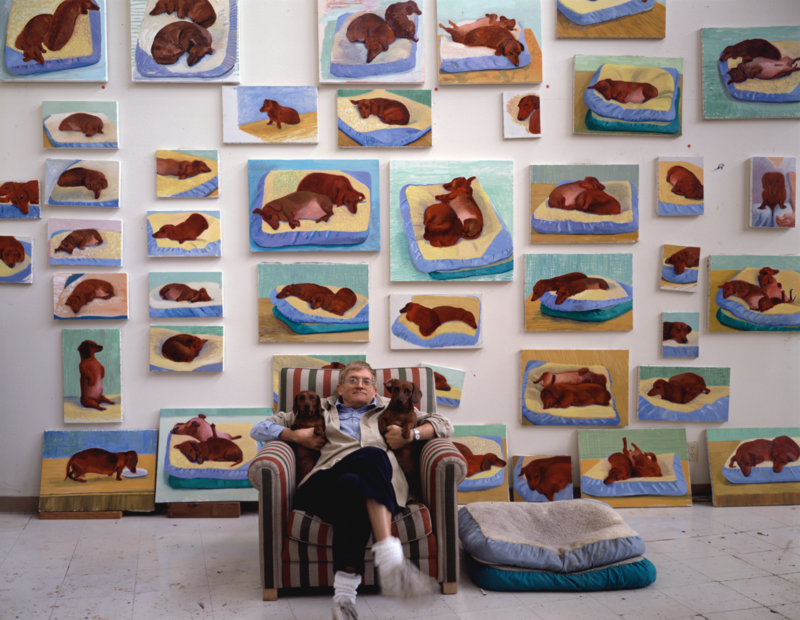
David Hockney died on 11 June 2026, aged 88. And he died working. When he died, exhibitions devoted to his recent work were still open to the public: in London, Serpentine was showing A Year in Normandie and Some Other Thoughts about Painting until 23 August 2026; in Margate, Turner Contemporary was keeping Sunley Window 2026 on view until 1 November.
So this was not an artist who had spent years in retirement, looking back at his own history from a distance. Hockney kept working almost until the very end of a career that lasted more than six decades.
He was born on 9 July 1937 in Bradford, Yorkshire, the fourth of five children. He first studied at Bradford School of Art and, from 1959, at the Royal College of Art in London. In 1964 he travelled to Los Angeles for the first time and found something there that would completely change his painting: a different light, a different climate, swimming pools, modern houses and a visual culture with very little in common with the England in which he had grown up.
California would become one of Hockney’s most recognisable images.
But to reduce him to blue swimming pools would be to keep only the postcard.
Painting something that lasts one second
In A Bigger Splash, from 1967, we do not see the person who has just jumped into the pool.
They have already disappeared.
The house remains completely still, the sky seems motionless and the lines are clean. In the middle of all that calm appears an enormous white explosion of water.
And that is precisely where things become interesting.
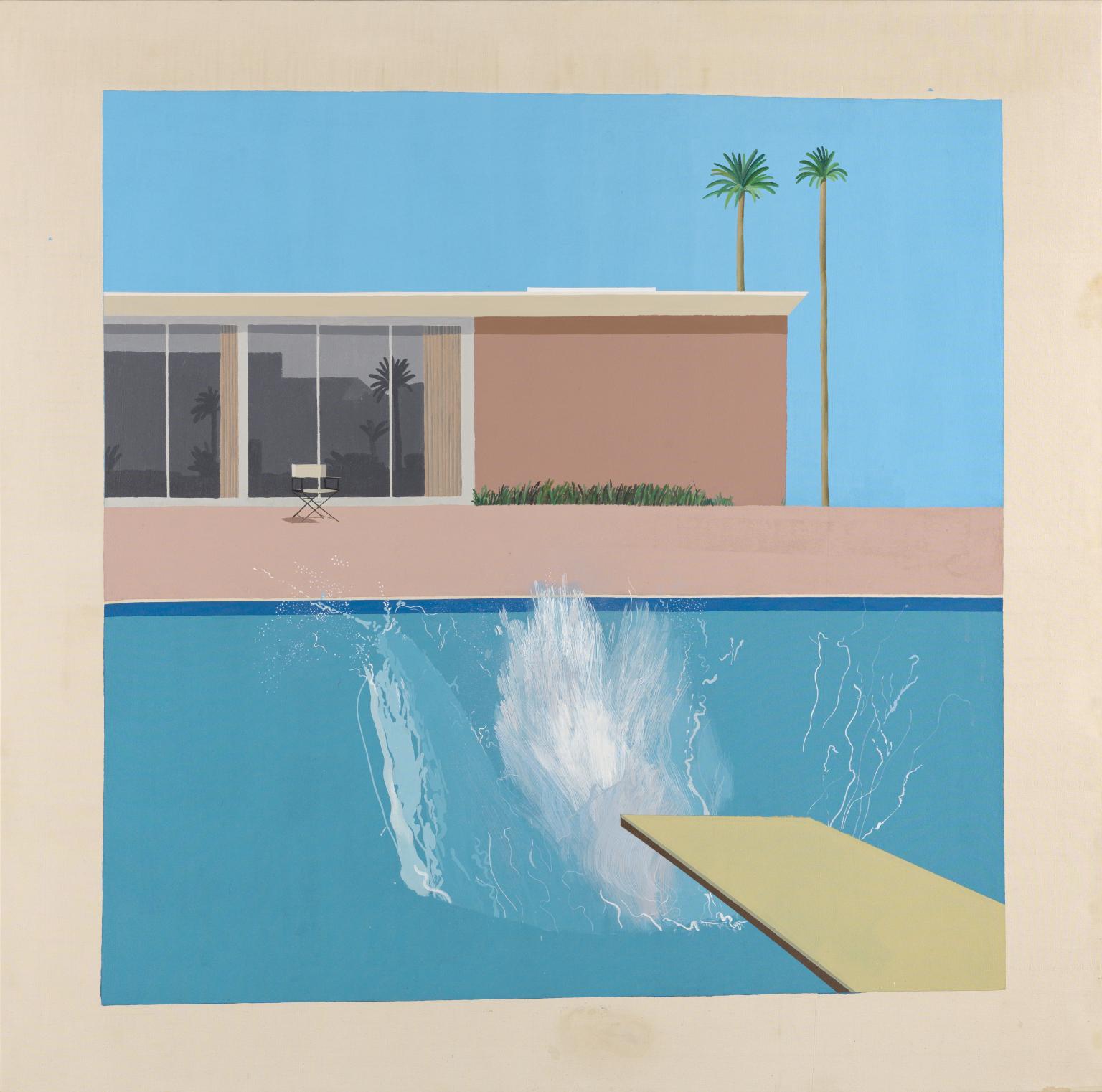
David Hockney, A Bigger Splash, 1967. Approved press image, courtesy of David Hockney Inc.
A splash lasts only a few seconds. Hockney, however, needed a slow and highly controlled process to make that instant remain on the canvas forever.
The swimming pools were not only the perfect symbol of California they would later appear to be.
They were also a problem.
How do you paint something transparent?
How do you paint water when it reflects what is above it and at the same time allows you to see what lies beneath?
How do you represent something that never stops moving?
Hockney returned to those questions again and again in works such as Sunbather, Portrait of Nick Wilder and A Bigger Splash.
And in fact, that obsession would run through his entire career: how we actually see things.
California also allowed him to represent male desire with much greater freedom. As early as the beginning of the 1960s, he had introduced explicit homosexual references into his paintings, at a time when sexual relations between men were still criminalised in England and Wales.
Hockney did not need to turn his paintings into manifestos.
He simply began to represent his own life without erasing from it what was supposedly meant to remain hidden.
Stanley and Boodgie
And then there were the dogs.
Between 1993 and 1995, Hockney began a completely different series.
The protagonists were Stanley and Boodgie, his two dachshunds.
They were not there as decoration within a scene, nor accompanying someone more important.
They were the scene.
In 1993 he began making small paintings and drawings of the two dogs from life and completed a series of 45 paintings in 1995. Part of that work would later be published in the 1998 book Dog Days.
Stanley and Boodgie appear sleeping together, curled up on cushions, looking away, waiting or simply resting.
Almost nothing happens.
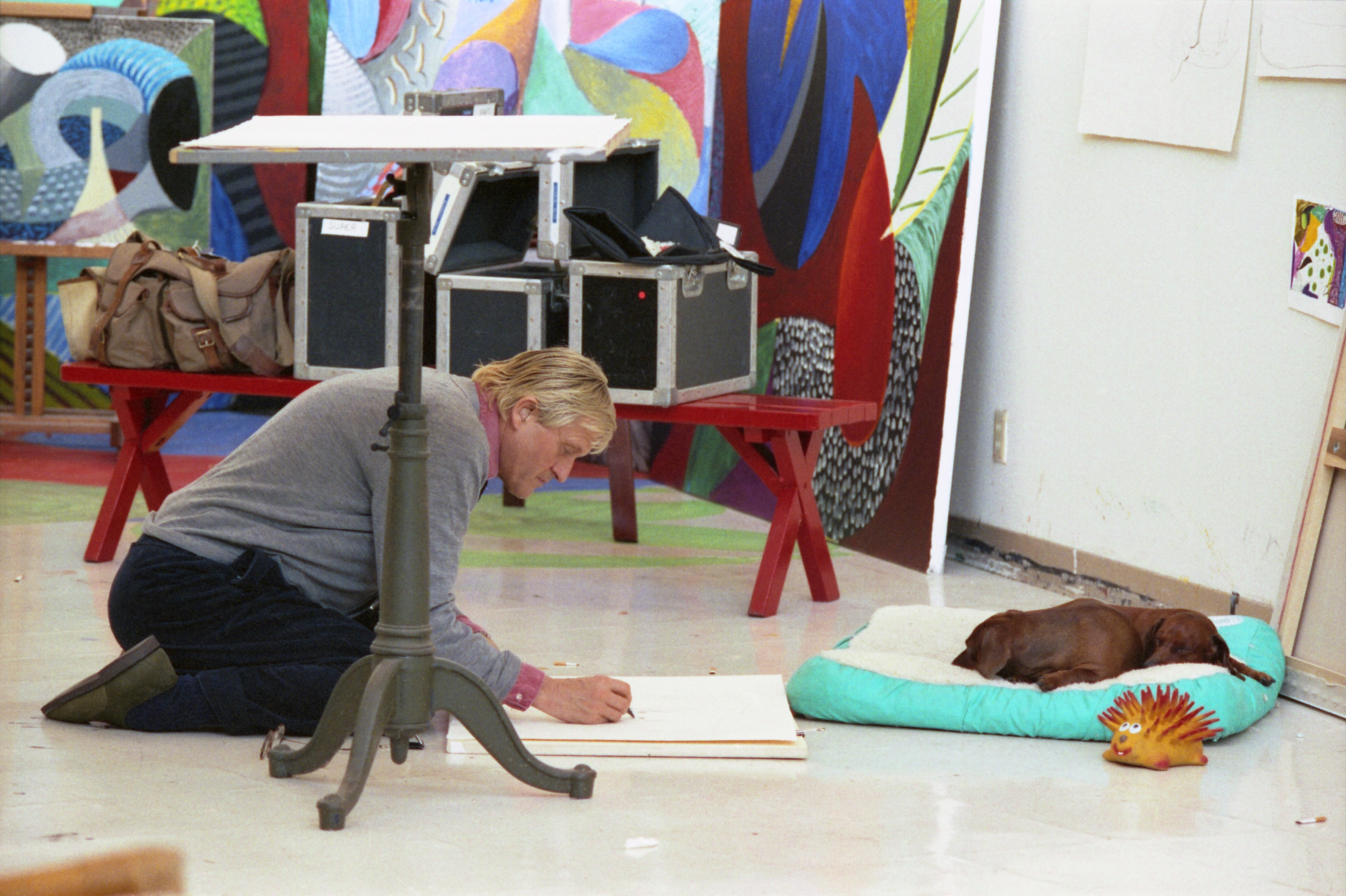
David Hockney drawing beside one of his dogs. Approved press image, courtesy of David Hockney Inc.
And that is precisely what makes it beautiful.
For years Hockney had painted the people he loved: lovers, friends, parents, collaborators. His dogs entered exactly the same world.
They were not simply “David Hockney’s dogs”.
They were two beings he saw every day, knew perfectly well and in whom he could notice tiny differences that would probably have gone unnoticed by anyone else.
In 1994 he even exhibited those portraits alongside drawings of family and friends under the title Some Drawings of Family, Friends and Best Friends 1993–1994.
The dogs were, literally, his best friends.
And perhaps that contains one of the simplest and most beautiful things in all his work.
Hockney did not need something extraordinary to happen before deciding that it deserved to be painted.
A sleeping dog was enough.
Painting the people in his life
The same attention appears constantly in his portraits.
Hockney painted people close to him again and again: Peter Schlesinger, Celia Birtwell, Ossie Clark, Henry Geldzahler, Christopher Isherwood, Don Bachardy and, of course, his parents.
Seen together, many of those paintings resemble a kind of autobiography told through other people.
One of the best-known examples is Mr and Mrs Clark and Percy, painted between 1970 and 1971.
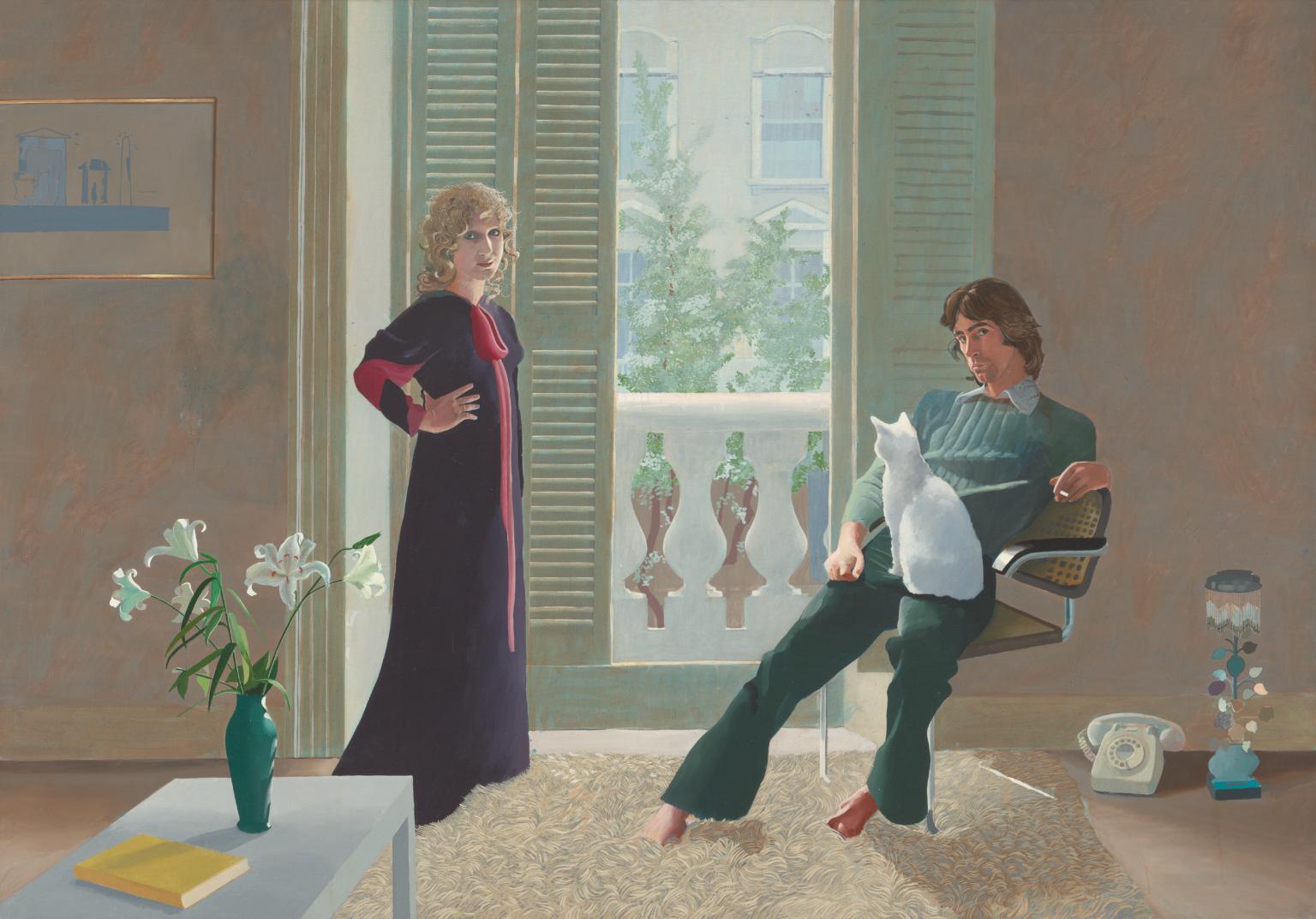
David Hockney, Mr and Mrs Clark and Percy, 1970–71. Approved press image, courtesy of David Hockney Inc.
The sitters are Celia Birtwell and Ossie Clark, friends of Hockney. He had been best man at their wedding. Percy, despite the title, was not actually the cat shown in the painting: the animal portrayed was Blanche. The name Percy remained in the title.
In My Parents, from 1977, Hockney turned back towards his own family.
His mother sits looking directly ahead. His father reads.
Nothing spectacular seems to be happening, yet once again that is precisely where his ability appears: turning an entirely ordinary situation into something worth looking at for a very long time.
Kenneth Hockney died in 1979.
The painting would also become one of the most recognisable family portraits of Hockney’s career.
Hockney looked at a person almost in the same way he looked at a swimming pool, a road or a dog.
Patiently.
A camera does not have two eyes
During the 1980s he became increasingly interested in something that seems obvious until you stop to think about it.
A camera does not see the way we do.
A camera fixes a single point of view and a single instant.
We do not.
We move our heads. We walk around things. We look at one part first and another afterwards. We remember what we have just seen while looking at something new.
In 1982 Hockney began working intensively with compositions made from multiple Polaroids and, later, 35 mm photographs.
The images overlapped, showing the same space from different angles or at different moments.
He called them joiners.
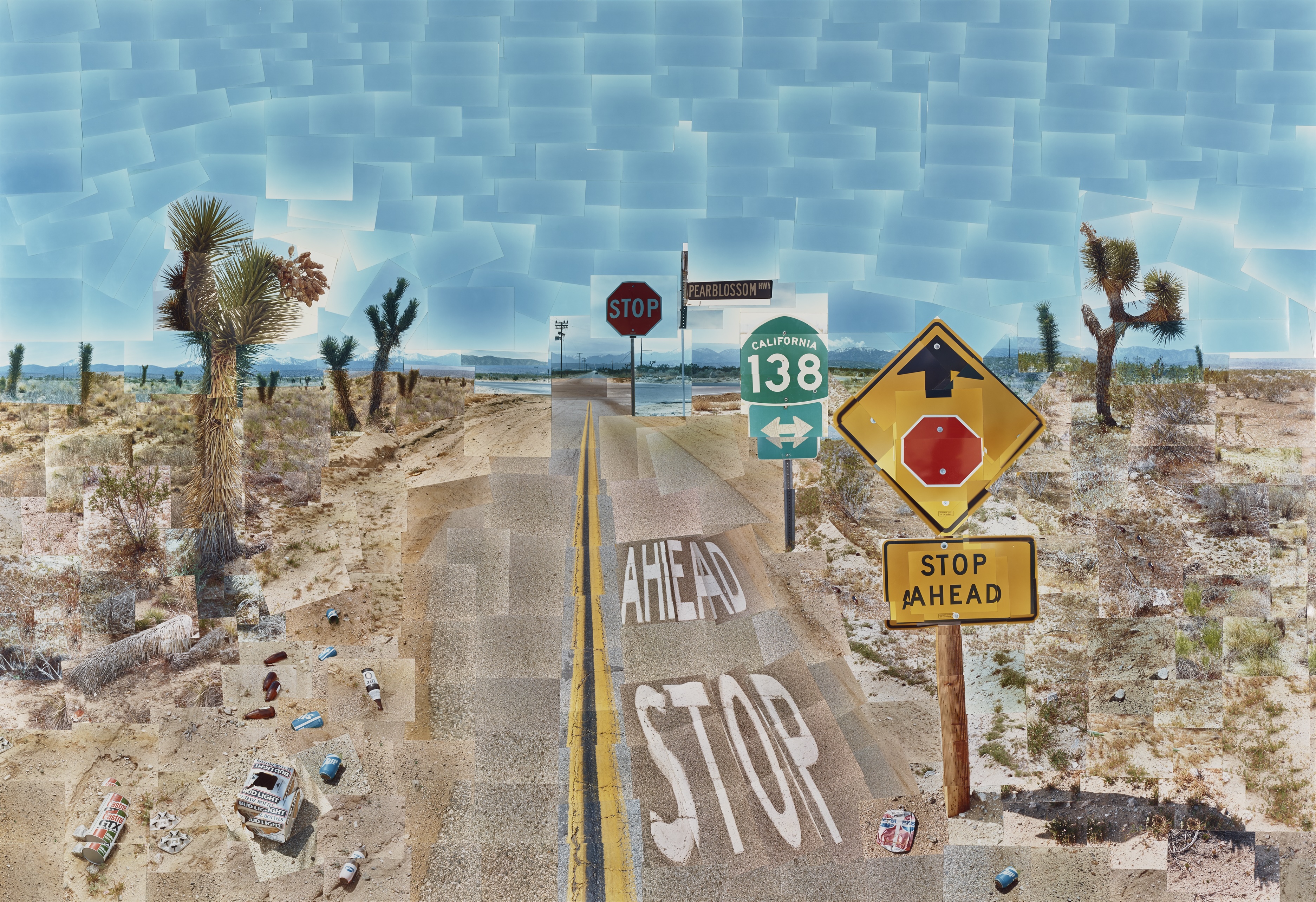
David Hockney, Pearblossom Hwy., 11–18th April 1986, #2, 1986. Approved press image, courtesy of David Hockney Inc.
Instead of using photography to obtain a supposedly more realistic image, he did almost the opposite: he dismantled it.
Because for Hockney, a single photograph could resemble our real experience of looking less than many images placed together.
Then came photocopiers, fax, video, digital printing, the iPhone and the iPad.
He never seemed especially interested in deciding which one was “his” definitive tool.
If something new appeared that could help him investigate how we see, he tried it.
Returning to Yorkshire
For decades it was almost impossible to separate Hockney from Los Angeles.
But from the late 1990s onwards he began looking closely again at the landscape of Yorkshire, the place where he had grown up.
And the visual change was enormous.
Many of those Californian swimming pools disappeared, and roads, trees, fields and seasons began to appear instead.
Greens.
Ochres.
Violets.
Roads disappearing between hills.
In 2007 he made Bigger Trees Near Warter, a work composed of 50 canvases and measuring roughly twelve metres across.
A year later he donated it to Tate.
There is something quite revealing in that.
After decades experimenting with photography, technology and new ways of constructing an image, Hockney kept returning to something as basic as going outside and looking at a tree.
Normandy: painting time
In his later years he spent long periods working in Normandy.
There he returned to an obsession that had already appeared in Yorkshire: observing how a landscape changes as time passes.
Between 2020 and 2021 he created A Year in Normandie, an enormous frieze built from iPad drawings made through the different seasons.
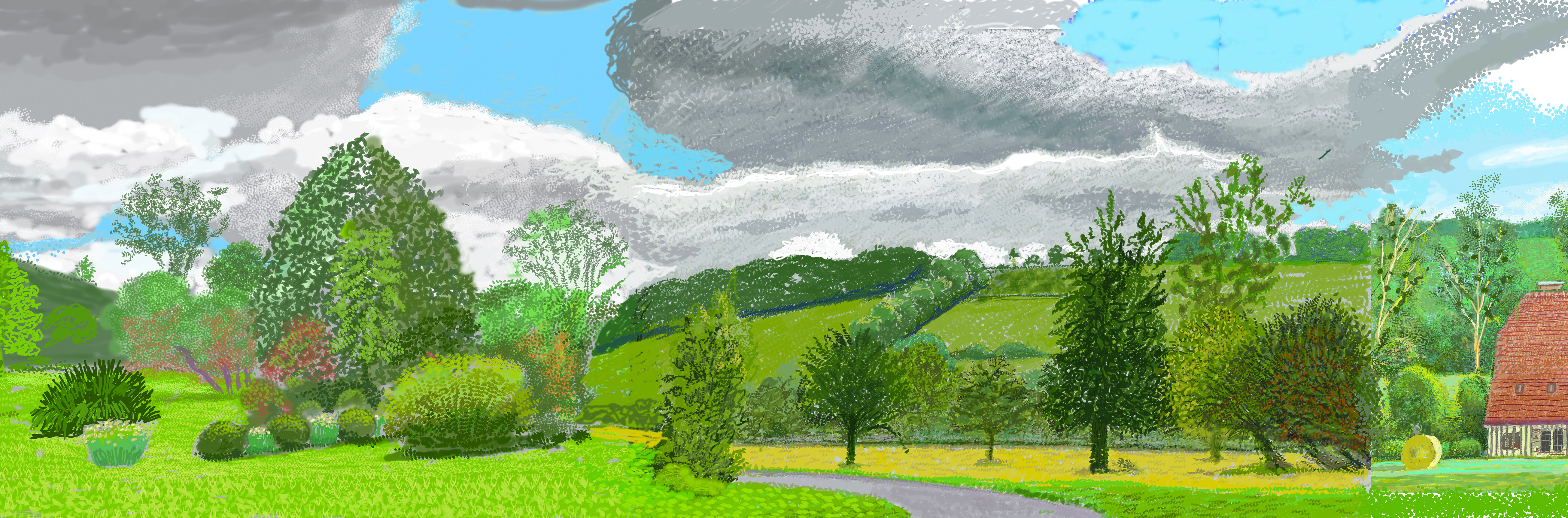
David Hockney, A Year in Normandie (detail), 2020–2021. Approved press image, courtesy of David Hockney Inc.
Trees.
Flowers.
Rain.
Changes in light.
Small transformations that pass completely unnoticed unless you look carefully.
In 2026, Serpentine presented A Year in Normandie and Some Other Thoughts about Painting in London. The exhibition opened on 12 March and was scheduled to run until 23 August.
That same year, on 1 April, Turner Contemporary opened Sunley Window 2026 in Margate, an intervention measuring roughly seven by ten metres based on a Normandy sunrise originally drawn on an iPad. It was scheduled to remain on view until 1 November.
Hockney died on 11 June 2026.
Part of his most recent work was still being presented to the public as something new.
There was no clear separation between the historical Hockney and an artist who had stopped investigating years before.
He was still working.
Still trying things.
And above all, still looking.
He never found a definitive technique
Some artists find a formula and spend decades repeating it.
Hockney did almost the opposite.
He painted.
He drew.
He made prints.
He designed stage sets.
He dismantled photography.
He worked with video.
He experimented with digital tools.
And when it seemed he might finally abandon a technique, he returned to it.
Innovation in Hockney never consisted simply of using new devices.
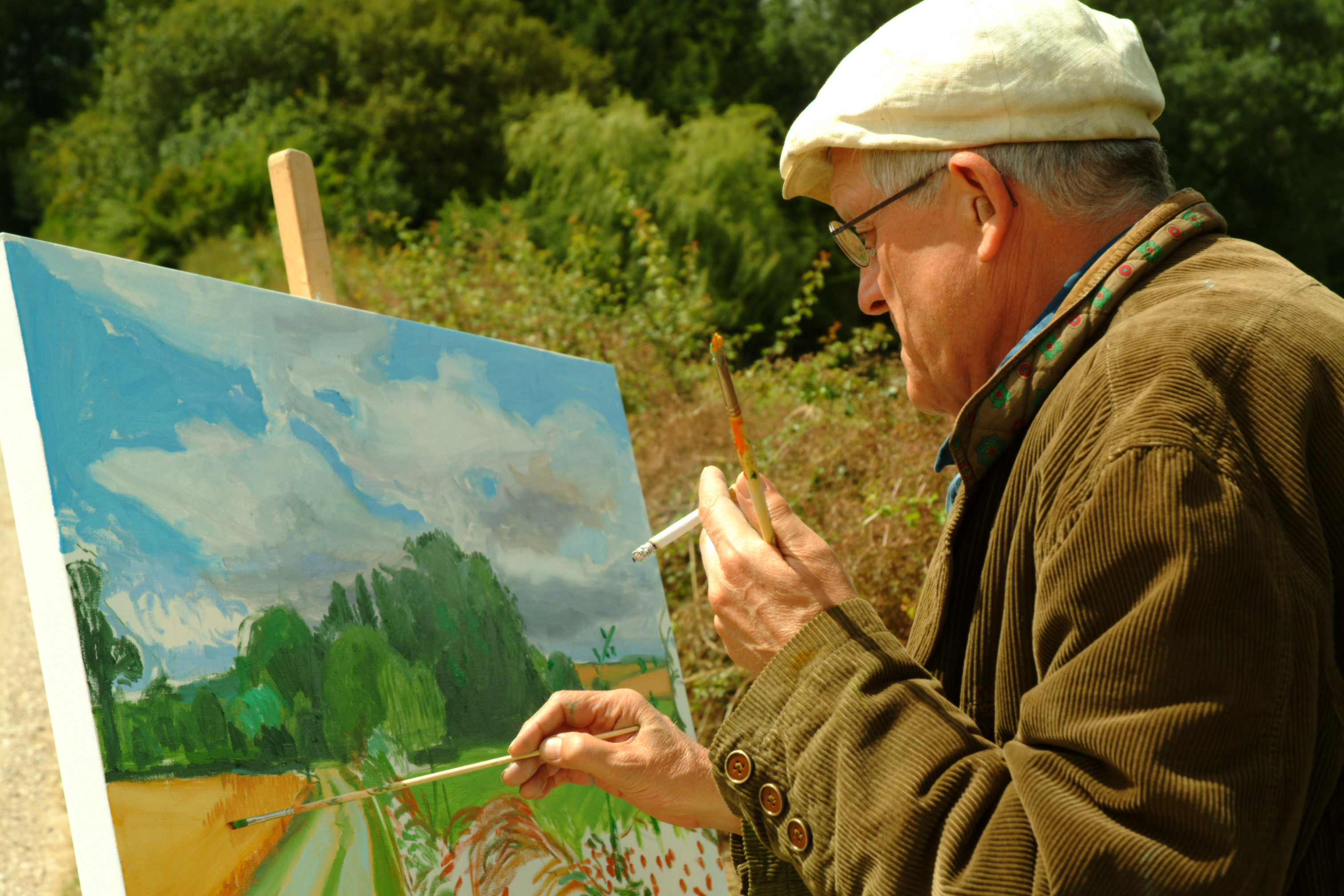
David Hockney working. Approved press image, courtesy of David Hockney Inc.
It consisted in never accepting that the problem of representing what we see had been solved.
The question remained.
How do we see?
Where to find Hockney
The following institutions hold works by David Hockney in their permanent collections. A work belonging to a museum does not necessarily mean that it is always on display, so it is worth checking before travelling.
Tate, London
Holds some of the key works of his career, including A Bigger Splash (1967), Mr and Mrs Clark and Percy (1970–71), My Parents (1977) and Bigger Trees Near Warter (2007), as well as numerous drawings, photographs and works on paper.
Art Institute of Chicago, Chicago
Its collection includes American Collectors (Fred and Marcia Weisman), from 1968, one of his major double portraits from the California period.
Museum of Modern Art (MoMA), New York
Holds a broad selection of prints and works on paper that make it possible to trace different stages of his career.
National Gallery of Art, Washington, D.C.
Has an extensive representation of his graphic and photographic work.
J. Paul Getty Museum, Los Angeles
Its collection includes photographic works that are particularly useful for understanding his investigation into multiple images and his relationship with California.
Keep looking
Hockney painted swimming pools, lovers, parents, friends, roads, trees, flowers, rooms and sleeping dogs.
On paper, it might sound like an excessively ordinary list for a career of more than sixty years.
Perhaps that is exactly where an important part of what he did can be found.
He did not need the world to be extraordinary.
He needed to look at it for long enough.
Stanley and Boodgie slept.
Someone had just disappeared beneath the water.
A tree changed slowly with the seasons.
A road stretched towards the horizon.
Hockney could return to the same place again and again because looking twice never meant seeing exactly the same thing.
After so many countries, so many techniques and so many experiments, the idea remained surprisingly simple:
keep looking.